USAID DEC
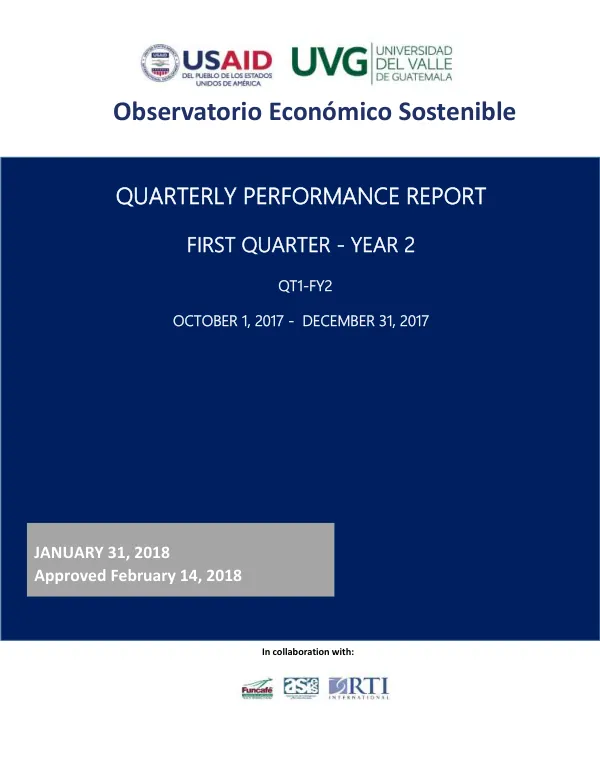
Quarterly Performance Report: First Quarter - Year 2 of the Sustainable Economic Observatory Project
Sign inDEPARTMENT OF AGRICULTURE
Quarterly Performance Report: First Quarter - Year 2 of the Sustainable Economic Observatory Project
The Sustainable Economic Observatory Project (SEOP) is a collaborative effort between the Universidad del Valle de Guatemala and various stakeholders, including government institutions, private sector organizations, and international non-governmental organizations.
2018 · 39 pages
Sign in to readA free account is required to download.
Abstract
The project aims to promote sustainable economic development in Guatemala by analyzing policies, participating in dialogue, and advocating for effective implementation and legislation. The SEOP's Research Agenda, formulated and validated in year one, outlines the research profiles that the project must carry out during the second year to design and implement policy instruments, government programs, or laws prioritized in the Issues Agenda. The Research Agenda was developed through a process of consultation and validation with experts in key topics, including private sector organizations, civil society groups, government institutions, and international cooperation programs. In year two, the SEOP introduces an innovative approach to promote sustainable economic development and achieve progress in national policies and programs. The project implements its Research Agenda by topic, building civil society capacity to analyze policies, participate in dialogue, and advocate for government decision-making to reduce poverty and chronic malnutrition, improve competitiveness, and enhance environmental and natural resource management. One of the first activities during the first quarter of the second year was the preparation and actualization of the annual work plan for year two. This process required several discussions with governmental officials, implementing organizations, private sector organizations, academia, and non-governmental organizations, including the Ministry of Agriculture, the Ministry of Finance, the Secretariat of Food Security and Nutrition, PRONACOM, The Nature Conservancy, and FUNDESA. The project also coordinated with the United States Department of Agriculture and other USAID projects, such as HEP+ and FAIR, to establish the necessary actions. The SEOP's progress in the first quarter of the second year is focused on advancing the coordination to implement the Research Agenda, which was formulated and validated in year one. The project's main achievements are related to the advance in the coordination to implement the Research Agenda, which was developed through a process of consultation and validation with experts in key topics. The SEOP's geographic focus is on Guatemala, with a specific emphasis on the Western Highlands region, which includes the departments of Quetzaltenango, San Marcos, Totonicapán, Huehuetenango, and Quiché. The project's timeframes are from October 1, 2017, to December 31, 2017, and the reporting period is from January 1, 2018, to January 31, 2018. The SEOP's implementation details include the preparation and actualization of the annual work plan for year two, which required several discussions with governmental officials, implementing organizations, private sector organizations, academia, and non-governmental organizations. The project also coordinated with the United States Department of Agriculture and other USAID projects to establish the necessary actions. The SEOP's key findings and methodologies include the formulation and validation of the Research Agenda, which was developed through a process of consultation and validation with experts in key topics. The project's implementation details include the preparation and actualization of the annual work plan for year two, which required several discussions with governmental officials, implementing organizations, private sector organizations, academia, and non-governmental organizations. The SEOP's conclusions and recommendations include the need to continue advancing the coordination to implement the Research Agenda, which was formulated and validated in year one. The project's main achievements are related to the advance in the coordination to implement the Research Agenda, which was developed through a process of consultation and validation with experts in key topics. The SEOP's monitoring and evaluation (M&E) framework includes the tracking of progress in implementing the Research Agenda, which was formulated and validated in year one. The project's M&E results for the first quarter of the second year show that the SEOP has made significant progress in advancing the coordination to implement the Research Agenda. The SEOP's planned activities for the second quarter of the second year include the continuation of the implementation of the Research Agenda, which was formulated and validated in year one. The project's upcoming events include the participation in the Forum of Development Studies of the UVG's Masters Development, which will bring together experts in key topics to discuss the implementation of the Research Agenda. The SEOP's administrative and financial management includes the procurement of goods and services, the management of human resources, and the administration of sub-awards. The project's financial management includes the management of the Rapid Response Fund (RRF), which is used to respond to emerging needs and opportunities. The SEOP's counterpart contribution includes the participation of the Government of Guatemala, which has provided support to the project through the Ministry of Agriculture, the Ministry of Finance, and the Secretariat of Food Security and Nutrition. The project's counterpart contribution also includes the participation of private sector organizations, civil society groups, and international non-governmental organizations, which have provided support to the project through their expertise and resources.