USAID DEC
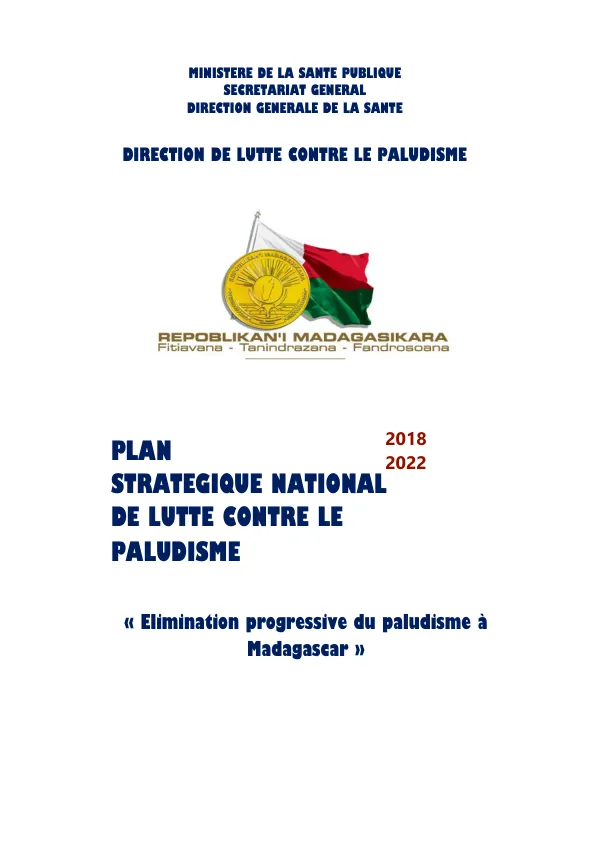
Plan Stratégique National de Lutte Contre le Paludisme 2018-2022
The Ministry of Public Health, General Secretariat, General Directorate of Public Health, Directorate of Malaria Control, in Madagascar, has developed a Strategic Plan for Malaria Control from 2018 to 2022.
2018 · 96 pages
Sign in to readA free account is required to download.
Abstract
The plan aims to eliminate malaria progressively in Madagascar. The strategic plan is based on the vision of reducing malaria incidence and mortality rates in the country. The current situation of malaria in Madagascar is characterized by a high incidence and prevalence of the disease. According to epidemiological data, the country is divided into three strata based on malaria transmission intensity: high, moderate, and low. The high-transmission stratum accounts for 70% of the country's population and is concentrated in the western and central regions. The moderate-transmission stratum covers 20% of the population and is found in the eastern and southern regions. The low-transmission stratum accounts for 10% of the population and is located in the northern region. The performance of the malaria control program in Madagascar has been evaluated based on several indicators. The program has achieved significant progress in reducing malaria incidence and mortality rates. The incidence of malaria has decreased by 30% between 2015 and 2017, while the mortality rate has decreased by 25% during the same period. The program has also improved the coverage of malaria prevention and treatment services, particularly in the high-transmission stratum. The strategic plan for malaria control in Madagascar aims to achieve several objectives, including reducing malaria incidence and mortality rates, improving the coverage of malaria prevention and treatment services, and strengthening the capacity of the health system to respond to malaria outbreaks. The plan is based on eight strategic axes, including the reinforcement of program management, the improvement of supply chain management, the consolidation of the prevention framework, and the improvement of surveillance and monitoring systems. The plan also includes several specific interventions aimed at reducing malaria incidence and mortality rates, particularly among vulnerable populations such as pregnant women and children under five years of age. The plan proposes the use of insecticide-treated bed nets, indoor residual spraying, and artemisinin-based combination therapies to treat malaria cases. The plan also aims to improve the coverage of malaria prevention and treatment services, particularly in the high-transmission stratum. The expected impact of the strategic plan for malaria control in Madagascar is a significant reduction in malaria incidence and mortality rates. The plan aims to reduce the incidence of malaria by 50% and the mortality rate by 75% by 2022. The plan also aims to improve the coverage of malaria prevention and treatment services, particularly in the high-transmission stratum. The plan is based on several hypotheses, including the assumption that the use of insecticide-treated bed nets and indoor residual spraying will reduce malaria incidence by 30%, and the assumption that the use of artemisinin-based combination therapies will reduce malaria mortality by 25%. The plan also assumes that the improvement of supply chain management and the consolidation of the prevention framework will improve the coverage of malaria prevention and treatment services. The plan includes a budget estimate of 88 billion Ariary for the period 2018-2022, which will be financed by the government of Madagascar, the Global Fund, and other development partners. The plan also includes a detailed description of the organizational structure of the malaria control program, including the roles and responsibilities of the different stakeholders involved in the program. The plan is based on a comprehensive analysis of the current situation of malaria in Madagascar, including the epidemiology of the disease, the performance of the malaria control program, and the capacity of the health system to respond to malaria outbreaks. The plan is also based on a thorough review of the literature on malaria control and the experiences of other countries in the region. The plan includes several annexes, including a brief description of Madagascar, the organizational structure of the Ministry of Public Health and the Directorate of Malaria Control, the framework for surveillance and monitoring, and the specific interventions aimed at reducing malaria incidence and mortality rates among vulnerable populations.
Related documents