JSI RESEARCH & TRAINING INSTITUTE, INC
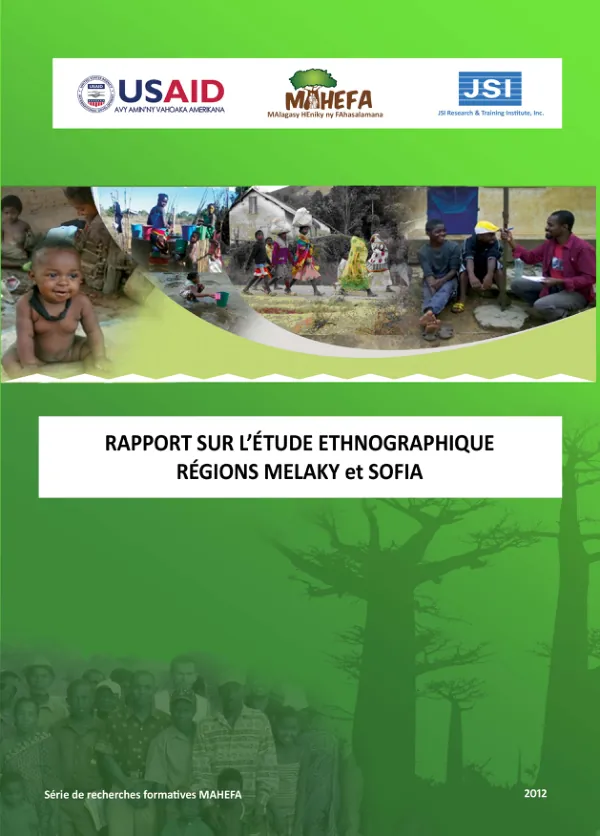
Rapport de l'étude ethnographique Régions Melaky et Sofia
The integrated community health program, MAHEFA, conducted an ethnographic study in the Melaky region from March 10 to April 13, 2012.
2012 · 153 pages
Sign in to readA free account is required to download.
Abstract
The study was led by students from the Department of Sociology at the University of Antananarivo, with the assistance of MAHEFA and funding from the United States Agency for International Development. The study aimed to understand the social organization, health practices, and perceptions of health among the local population. The study focused on two sites, Belitsaky and Betanatanana, and collected data on the local economy, access to healthcare, and demographic characteristics. The researchers also conducted in-depth interviews with community members to gather information on their social organization, decision-making processes, and health practices. In the Belitsaky site, the study found that the local population is organized into a hierarchical social structure, with a strong emphasis on traditional practices and taboos. The researchers observed that women have a lower social status and are often excluded from decision-making processes related to health. The study also found that the local population has limited access to clean water, sanitation facilities, and healthcare services. In terms of health practices, the study found that the local population has a strong belief in traditional medicine and often seeks treatment from traditional healers. The researchers also observed that the local population has limited knowledge about modern healthcare practices, such as vaccination and the use of insecticide-treated bed nets. The study found that the local population has a high prevalence of infectious diseases, including malaria and sexually transmitted infections. The study also collected data on the local population's perceptions of health and disease. The researchers found that the local population has a strong belief in the importance of hygiene and cleanliness, but often lacks access to the necessary resources to maintain good hygiene practices. The study also found that the local population has a limited understanding of the causes of disease and often attributes illness to supernatural forces. In the Betanatanana site, the study found similar patterns of social organization and health practices as in the Belitsaky site. The researchers observed that the local population has a strong emphasis on traditional practices and taboos, and that women have a lower social status and are often excluded from decision-making processes related to health. The study also found that the local population has limited access to clean water, sanitation facilities, and healthcare services. The study's findings have important implications for the development of healthcare programs in the Melaky region. The researchers recommend that healthcare programs should be tailored to the local population's needs and should take into account the social and cultural context in which they operate. The study also recommends that healthcare programs should focus on improving access to clean water, sanitation facilities, and healthcare services, as well as promoting modern healthcare practices and improving the local population's knowledge about health and disease. The study's findings also highlight the importance of involving local communities in the development of healthcare programs. The researchers recommend that healthcare programs should be developed in collaboration with local communities, and that local communities should be involved in the decision-making process related to healthcare. The study also recommends that healthcare programs should be designed to be culturally sensitive and should take into account the local population's values and beliefs. Overall, the study provides valuable insights into the social organization, health practices, and perceptions of health among the local population in the Melaky region. The study's findings have important implications for the development of healthcare programs in the region and highlight the need for culturally sensitive and community-based approaches to healthcare.
Related documents