USAID DEC
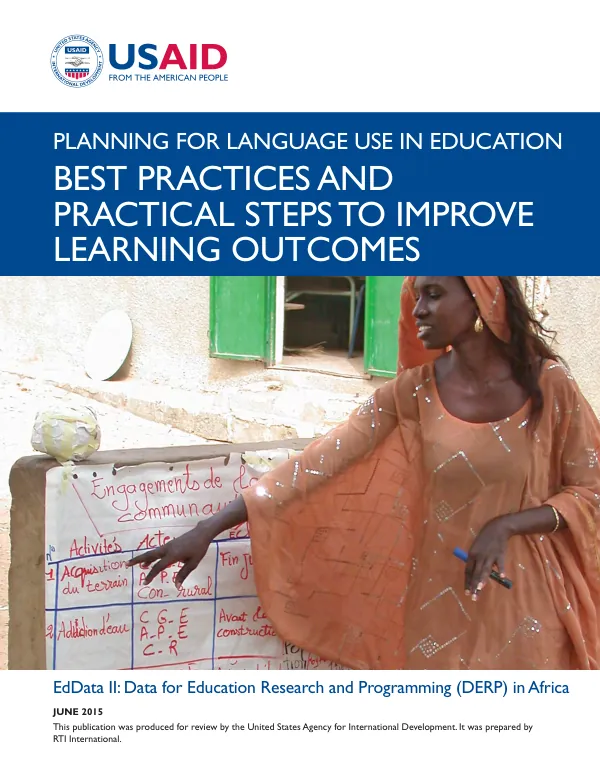
Planning for Language Use in Education: Best Practices and Practical Steps to Improve Learning Outcomes
Sign inRTI INTERNATIONAL
Planning for Language Use in Education: Best Practices and Practical Steps to Improve Learning Outcomes
Language planning in education is a critical component of improving learning outcomes, particularly in countries where linguistic diversity is prevalent.
2015 · 95 pages
Sign in to readA free account is required to download.
Abstract
The concept of Education for All, as operationalized by the Millennium Development Goals, drives current efforts in educational development. The assumption underlying the expansion of formal basic education to all children is that this education will improve their opportunities to have healthy, productive lives. Research on language, literacy, and learning has identified several key factors to consider when planning for language use in education. These factors include the relationship between language of instruction (LOI) and the goals of the education system, the sociolinguistic context, and the educational context. The sociolinguistic context encompasses the language environment, language development and standardization, and language use in the community. The educational context includes the curriculum, instructional materials, and assessment tools used in schools. Effective language planning requires a comprehensive approach that takes into account the needs and perspectives of various stakeholders, including teachers, students, parents, and community members. This involves conducting a situation analysis and assembling country-specific information, engaging a wide range of stakeholders and conducting social advocacy, identifying pedagogical approaches and specific languages to use, and supporting language standardization and development. A key consideration in language planning is the choice of language of instruction. Research has shown that using the mother tongue as the language of instruction can improve learning outcomes, particularly for students who are linguistically diverse. However, this approach also requires careful planning and implementation to ensure that students have access to high-quality instructional materials and teacher training. The document provides a practical framework for planning for language use in education, including a series of steps and recommendations for countries to follow. These steps include conducting a situation analysis, engaging stakeholders, identifying pedagogical approaches, supporting language standardization, and developing a language policy and/or language plan. The document also includes a detailed literature review of worldwide evidence and best practices on L1-based multilingual instruction, as well as a series of annexes that provide additional resources and tools for language planning. Overall, the document provides a comprehensive and practical guide for countries to improve language planning in education and ultimately improve learning outcomes for all students. By taking a comprehensive and inclusive approach to language planning, countries can ensure that all students have access to high-quality educational services, regardless of their linguistic background or other characteristics.
Related documents
Documents in this collection
 2019
2019USAID DEC
USAID Arithmetic and Inclusive Education Activity (AIE) Guide to Minimum Required Characteristics of an Inclusive Learning Environment for Children with Disabilities Reached through AIE
Open record 2018
2018USAID DEC
Malawi Teacher Professional Development Support Project (MTPDS) Teacher's Training Manual
Open record