RTI INTERNATIONAL
Evidence Document for Scaling Up Education Reform: Annex F
Creating Education Systems Coherent for Learning Outcomes: Making the Transition from Schooling to Learning is a key concept in education reform.
2019 · 15 pages
Sign in to readA free account is required to download.
Abstract
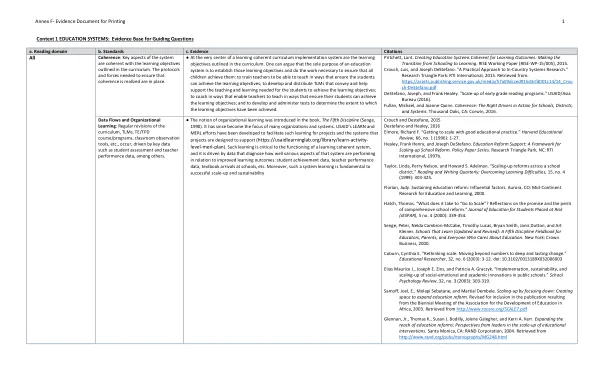
This transition involves establishing learning objectives outlined in the curriculum and ensuring that all children achieve them. The sole purpose of an education system is to establish those learning objectives and do the work necessary to ensure their achievement. This includes training teachers to teach in ways that enable students to achieve the learning objectives, developing and distributing teaching and learning materials (TLMs) that convey and support the teaching and learning needed for students to achieve the learning objectives, coaching teachers to enable them to teach in ways that ensure their students can achieve the learning objectives, and developing and administering tests to determine the extent to which the learning objectives have been achieved. Organizational learning is critical to the functioning of a learning coherent system. This type of learning is driven by data that diagnose how well various aspects of the system are performing in relation to improved learning outcomes. Student achievement data, teacher performance data, textbook arrivals at schools, and other key indicators are used to inform decision-making and drive improvements in the education system. The notion of organizational learning was introduced in Peter Senge's book, The Fifth Discipline, and has since become a focus of many organizations and systems. USAID's LEARN and MERL efforts have been developed to facilitate such learning for projects and the systems that projects are designed to support. Protocols outlining the measures to be taken and the institutional forces needed to ensure that the protocols are implemented are essential for a learning coherent system. A protocol outlines a series of steps or procedures that are to be undertaken when particular conditions are met. In a hospital emergency room, the life of the patient impels doctors and nurses to follow the protocols. In the education system, job descriptions and performance appraisal systems can exert such force, as can incentives and accountability pressure. For reform of any kind to be successful, key actors throughout the system must not only demand it, but they must own it as well. This means that there must be a high level of commitment for all of the reforms/standards called for in the education system. The level of commitment for all of the standards presented in this table is high. Key actors throughout the system must demand and own the reforms/standards called for in the education system. This level of commitment is essential for the successful implementation of education reforms. The education system must have a robust set of protocols that outline what actions need to be taken when a particular condition has been met. The institutional forces needed to ensure that the protocols are implemented must also be in place. This includes job descriptions and performance appraisal systems, incentives, and accountability pressure. The education system must be able to scale up and sustain reforms over time, and this requires a high level of commitment from key actors throughout the system. The concept of coherence is central to the education system. Coherence refers to the alignment of the various components of the education system, including the curriculum, teaching and learning materials, teacher training, and assessment. When the components of the education system are coherent, they work together to achieve the learning objectives outlined in the curriculum. The education system must be able to diagnose how well various aspects of the system are performing in relation to improved learning outcomes, and use this information to drive improvements. This requires a robust set of protocols and institutional forces that can ensure the implementation of the protocols. The level of commitment for all of the standards presented in this table is high, and key actors throughout the system must demand and own the reforms/standards called for in the education system.
Related documents