USAID DEC
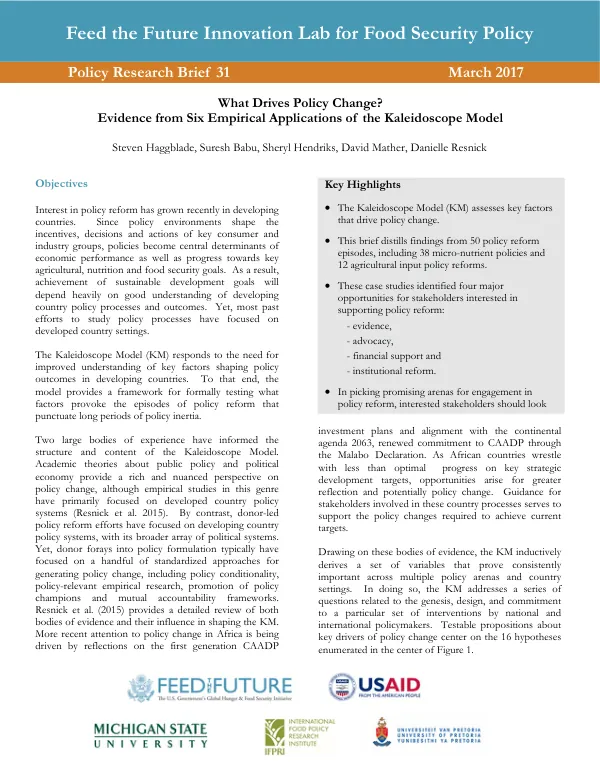
Policy_Brief_31: What Drives Policy Change? Evidence from Six Empirical Applications of the Kaleidoscope Model
Sign inUSAID
Policy_Brief_31: What Drives Policy Change? Evidence from Six Empirical Applications of the Kaleidoscope Model
The Kaleidoscope Model (KM) is a framework for understanding policy change in developing countries.
2017 · 6 pages
Sign in to readA free account is required to download.
Abstract
The model was developed in response to the need for improved understanding of policy processes in these countries, which are critical determinants of economic performance and progress towards key agricultural, nutrition, and food security goals. The KM provides a framework for formally testing what factors provoke episodes of policy reform that punctuate long periods of policy inertia. The model is informed by two large bodies of experience: academic theories about public policy and political economy, and donor-led policy reform efforts. Academic theories provide a rich and nuanced perspective on policy change, although empirical studies in this genre have primarily focused on developed country policy systems. Donor-led policy reform efforts have focused on developing country policy systems, with a broader array of political systems, but have typically relied on standardized approaches for generating policy change. The KM inductively derives a set of variables that prove consistently important across multiple policy arenas and country settings. These variables are centered on the 16 hypotheses enumerated in Figure 1. The model addresses a series of questions related to the genesis, design, and commitment to a particular set of interventions by national and international policymakers. Empirical evidence from six initial case studies provides the proving ground for field testing the KM and its associated research methods. The case studies examine concrete instances of policy change in different developing countries, aiming to explore the KM's relevance across differing political and policy systems. The case studies analyzed human micro-nutrient policies and changes in agricultural input subsidy policies, with a total of 50 policy reform episodes studied. The results of the case studies indicate that policy reform requires a burst of energy to overcome the inertia of existing vested interests. At the agenda-setting stage, three main factors routinely provoke rethinking of current policy positions: high-profile focusing events, powerful advocates, and recognized, relevant problems. In the case of micro-nutrient policies, international advocates led by UNICEF convened the 1990 World Summit for Children, while a coalition of nutrition advocates followed up with a series of international summits. At the design stage, forces driving the formulation of new policies differ across policy domains. The design of agricultural input subsidy modalities depends to a large extent on norms, core beliefs, and ideology, particularly deeply held beliefs about the fairness and efficiency of private markets. In contrast, micro-nutrient supplementation policies have proven less controversial and more frequently founded on international best-practice medical and nutritional scientific research and knowledge. Decisions to adopt a new policy depend on two primary factors: the relative power of proponents and opponents, and agreement of government veto players. Both of these variables proved important in the majority of both micro-nutrient and input subsidy policy changes reviewed. Implementation depends fundamentally on the availability of requisite budget resources, institutional delivery capacity, and the ongoing commitment of policy champions. With input subsidy programs, budget and implementation capacity constraints have proven especially acute, and changing budgetary resources frequently trigger reforms.