USAID DEC
Policy Brief: Integration of Phonics-Based Literacy Approaches into the Tanzanian Primary Curriculum
Sign inUSAID
Policy Brief: Integration of Phonics-Based Literacy Approaches into the Tanzanian Primary Curriculum
The Tanzanian primary curriculum has been a subject of reform efforts to improve literacy outcomes for lower and early grades.
2023 · 2 pages
Sign in to readA free account is required to download.
Abstract
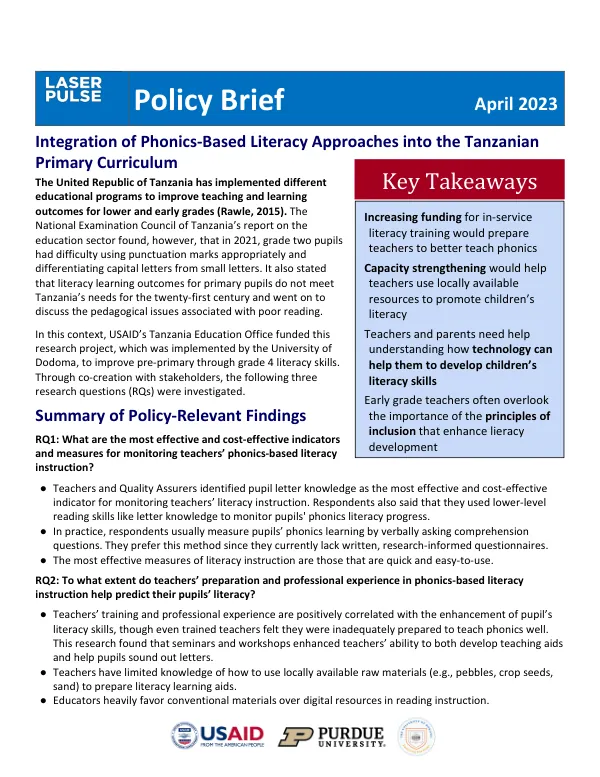
The National Examination Council of Tanzania's report on the education sector found that in 2021, grade two pupils had difficulty using punctuation marks appropriately and differentiating capital letters from small letters. This difficulty is attributed to poor reading skills, which are a result of inadequate phonics-based literacy instruction. Research conducted by the University of Dodoma, funded by USAID's Tanzania Education Office, aimed to improve pre-primary through grade 4 literacy skills. The study investigated three research questions through co-creation with stakeholders. The first research question focused on identifying effective and cost-effective indicators and measures for monitoring teachers' phonics-based literacy instruction. The study found that teachers and quality assessors identified pupil letter knowledge as the most effective and cost-effective indicator for monitoring teachers' literacy instruction. The study also found that teachers usually measure pupils' phonics learning by verbally asking comprehension questions, as they lack written, research-informed questionnaires. Furthermore, the most effective measures of literacy instruction are those that are quick and easy to use. The second research question explored the extent to which teachers' preparation and professional experience in phonics-based literacy instruction help predict their pupils' literacy. The study found that teachers' training and professional experience are positively correlated with the enhancement of pupils' literacy skills. However, even trained teachers felt they were inadequately prepared to teach phonics well. The study also found that seminars and workshops enhanced teachers' ability to develop teaching aids and help pupils sound out letters. Additionally, teachers have limited knowledge of how to use locally available raw materials to prepare literacy learning aids. Educators heavily favor conventional materials over digital resources in reading instruction. The study's findings highlight the need for capacity strengthening to help teachers use locally available resources to promote children's literacy. Increasing funding for in-service literacy training would prepare teachers to better teach phonics. Capacity strengthening would also help teachers positively interact with and better assist parents in making their homes environments promote literacy. Parents have a limited understanding of how the home environment helps students learn to read, and teachers should help coach them. The study also found that teachers and parents need help understanding how technology can help them develop children's literacy skills. Early grade teachers often overlook the importance of the principles of inclusion that enhance literacy development. The language barrier for minority-language pupils made teaching Kiswahili literacy challenging. Educators need more clarity on how language instruction could best support early grade children who were emerging bilinguals and were not yet fluent in spoken Kiswahili. The study's third research question explored the opportunities that exist within the education ecosystem for teachers to promote phonics-based literacy. The study found that teachers can better promote phonics literacy by improving how they work with families, using appropriate locally available and low-cost materials, and improving their use of technology. Better training would help them in these tasks. Teachers are generally unaware of the few available opportunities in the school system that would help them better teach children to read. The study's findings have significant implications for policy and practice. The Ministry of Education, Science and Technology could use in-service training like that organized by the USAID Tusome Pamoja project as a model. The Ministry of Education, Science and Technology and the Ministry of Education and Vocational Training should develop and institutionalize tools to assess phonics instruction, which would especially help quality assessors. The Ministry of Education, Science and Technology should strengthen teachers' capacity to positively interact with and better assist parents in making their homes environments promote literacy. Teachers and quality assessors currently struggle to use evidence-based means to measure pupils' literacy progress or assess literacy instruction. They report rarely receiving any support in these tasks. If they knew more about what effective, low-cost indicators to use, better reading instruction would result. Educational policy makers and donors should use professional development programs to make teachers more able to assess teaching and its outcomes.