ECO CONSULTING GROUP
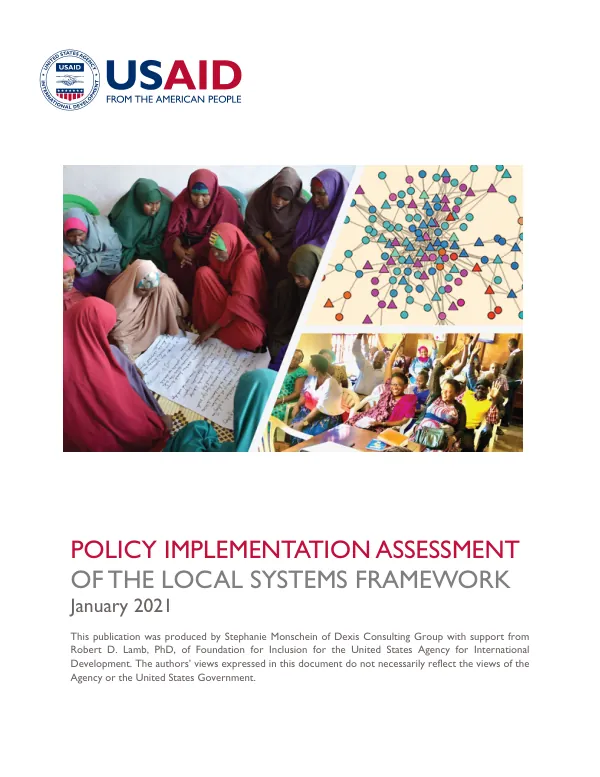
Policy Implementation Assessment of the Local Systems Framework, January 2021
The Local Systems Framework (LSF) was published by the United States Agency for International Development (USAID) six years ago as a policy document aimed at supporting sustained development.
2021 · 153 pages
Sign in to readA free account is required to download.
Abstract
The framework emphasizes the importance of designing development programming to produce sustainable results. However, the challenge for USAID has been to provide clarity about what should be sustained and how to design and implement accordingly. The LSF was a major attempt at providing USAID with guidance on this issue. The framework is based on the idea that development programming should focus on supporting local systems, which are defined as the networks of relationships, institutions, and processes that shape the behavior of individuals and organizations in a given context. By supporting local systems, development programming can help to create sustainable outcomes that are driven by local actors and institutions. The LSF has been implemented across various programs and processes within USAID, including the Country Development Cooperation Strategy (CDCS), the Project Appraisal Document (PAD), and the Monitoring, Evaluation, and Learning (MEL) system. However, the assessment found that there is a misalignment between USAID's culture and the principles of the LSF. This misalignment is reflected in the Agency's tendency to focus on short-term results and to prioritize technical assistance over local capacity building. The assessment also found that there are systemic enablers and constraints that affect the implementation of the LSF. Systemic enablers include the presence of strong local systems, a clear understanding of the local context, and a commitment to sustainability. Systemic constraints include the lack of resources, the presence of bureaucratic barriers, and the limited capacity of local institutions. Despite these challenges, the assessment identified opportunities for systemic transformation. These opportunities include the development of a more nuanced understanding of local systems, the creation of a more supportive institutional environment, and the development of more effective tools and approaches for supporting local capacity building. The assessment made several recommendations for improving the implementation of the LSF. These recommendations include the development of a more comprehensive understanding of local systems, the creation of a more supportive institutional environment, and the development of more effective tools and approaches for supporting local capacity building. The recommendations also include the need for USAID to prioritize sustainability and to focus on building local capacity, rather than relying on technical assistance. The assessment also highlighted the importance of systems thinking and local systems integration across USAID. The assessment found that there is a need for a more comprehensive understanding of local systems and for a more integrated approach to development programming. This requires a shift in the way that USAID approaches development programming, from a focus on technical assistance to a focus on building local capacity and supporting local systems. The assessment also emphasized the importance of agency support structures in supporting the implementation of the LSF. The assessment found that there is a need for a more supportive institutional environment, including the development of more effective tools and approaches for supporting local capacity building. This requires a commitment to sustainability and a focus on building local capacity, rather than relying on technical assistance. In conclusion, the assessment found that the implementation of the LSF has been limited by a misalignment between USAID's culture and the principles of the framework. However, the assessment also identified opportunities for systemic transformation and made several recommendations for improving the implementation of the LSF. These recommendations include the development of a more comprehensive understanding of local systems, the creation of a more supportive institutional environment, and the development of more effective tools and approaches for supporting local capacity building.