USAID
Policy Office Capability Framework
The Policy Office Capability Framework is designed to identify the essential behaviors, attitudes, actions, and skills required for policy officers at entry, mid, and managerial levels.
2016 · 4 pages
Sign in to readA free account is required to download.
Abstract
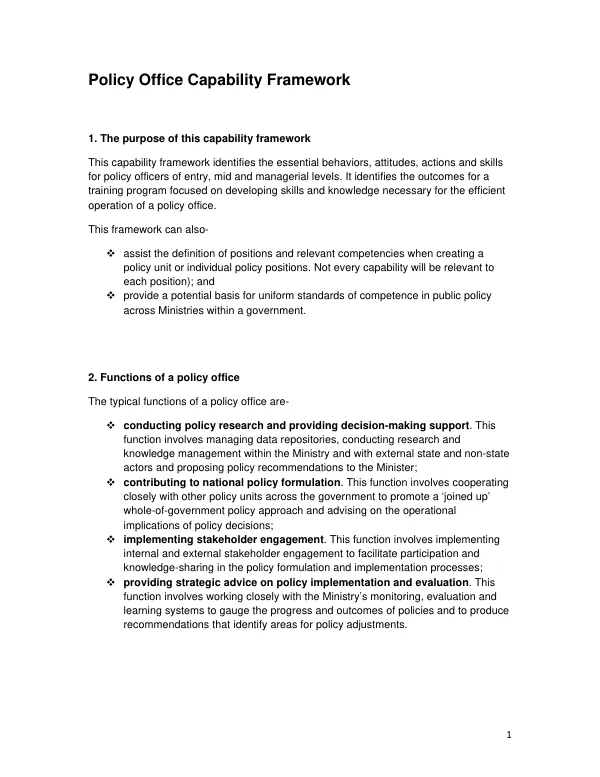
This framework aims to develop skills and knowledge necessary for the efficient operation of a policy office, enabling policy officers to effectively contribute to national policy formulation and implementation. The typical functions of a policy office include conducting policy research and providing decision-making support, contributing to national policy formulation, implementing stakeholder engagement, and providing strategic advice on policy implementation and evaluation. Policy officers are expected to possess strong knowledge of a professional field related to the policy subject matter of the Ministry, as well as computer and internet skills. The framework outlines six key capabilities for policy officers: Leadership and Management, Machinery of Government and the Public Policy Process, Strategic Co-ordination, Research and Analysis, Stakeholder Engagement, and Communication. These capabilities are categorized into three levels: entry, mid, and management. Leadership and Management capabilities include meeting deadlines, delivering effective outcomes, and proposing organizational strategies to position the Ministry to meet current and future challenges. Policy officers at the entry level are expected to meet deadlines and deliver effective outcomes, while those at the mid level are expected to propose and implement organizational strategies. Machinery of Government and the Public Policy Process capabilities involve understanding the roles and functions of government, including the legislative and executive decision-making processes. Policy officers at the entry level are expected to understand the roles and functions of government, while those at the mid level are expected to apply knowledge of government and the legislative and executive decision-making processes in policy development. Strategic Co-ordination capabilities include understanding the government's priorities and how they impact on policy, as well as understanding cross-jurisdictional and whole-of-government issues. Policy officers at the entry level are expected to understand the government's priorities, while those at the mid level are expected to advise and support cross-jurisdictional, whole-of-government, and Ministry agendas. Research and Analysis capabilities involve distinguishing between opinion and fact, collecting data, and undertaking basic research. Policy officers at the entry level are expected to distinguish between opinion and fact, while those at the mid level are expected to analyze and review literature and data, and draw logical conclusions from it. Stakeholder Engagement capabilities include coordinating stakeholder meetings, actively engaging with stakeholder networks, and building consensus with stakeholders regarding policy. Policy officers at the entry level are expected to coordinate stakeholder meetings, while those at the mid level are expected to build consensus with stakeholders. Communication capabilities involve writing in simple non-emotive language, creating basic policy documents, and attending meetings and contributing to them. Policy officers at the entry level are expected to write in simple non-emotive language, while those at the mid level are expected to write and edit concise, accurate, and logical policy documents. Overall, the Policy Office Capability Framework provides a comprehensive framework for developing the skills and knowledge necessary for policy officers to effectively contribute to national policy formulation and implementation.