PACT
Policy Paper on Natural Capital Valuation (NCV) for Madagascar
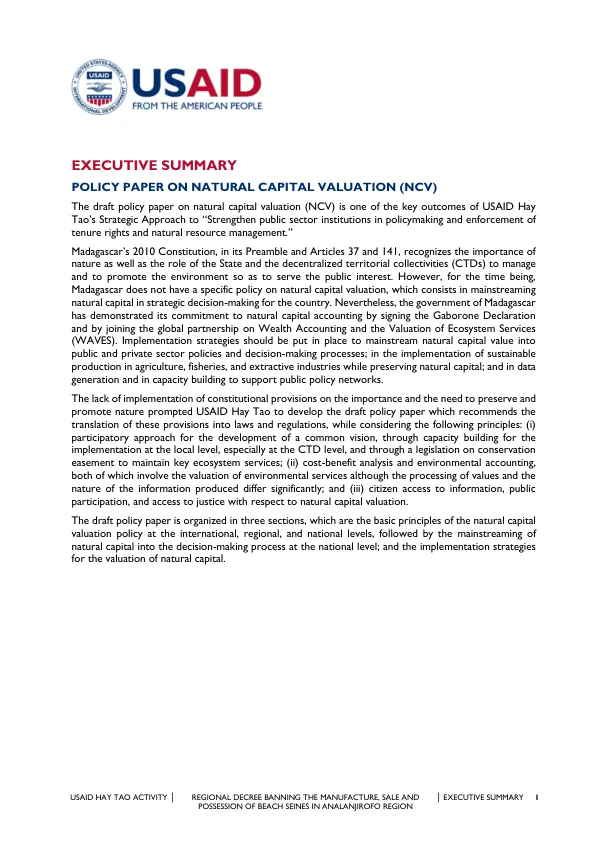
The draft policy paper on natural capital valuation (NCV) is a key outcome of USAID Hay Tao's Strategic Approach to strengthen public sector institutions in policymaking and enforcement of tenure rights and natural resource management.
17 pages
Sign in to readA free account is required to download.
Abstract
Madagascar's 2010 Constitution recognizes the importance of nature and the role of the State and decentralized territorial collectivities (CTDs) in managing and promoting the environment to serve the public interest. However, Madagascar lacks a specific policy on natural capital valuation, which involves mainstreaming natural capital in strategic decision-making for the country. The government of Madagascar has demonstrated its commitment to natural capital accounting by signing the Gaborone Declaration and joining the global partnership on Wealth Accounting and the Valuation of Ecosystem Services (WAVES). Implementation strategies should be put in place to mainstream natural capital value into public and private sector policies and decision-making processes, in the implementation of sustainable production in agriculture, fisheries, and extractive industries while preserving natural capital, and in data generation and capacity building to support public policy networks. The draft policy paper recommends translating constitutional provisions on the importance and need to preserve and promote nature into laws and regulations, considering the following principles: (i) participatory approach for the development of a common vision, through capacity building for implementation at the local level, especially at the CTD level, and through a legislation on conservation easement to maintain key ecosystem services; (ii) cost-benefit analysis and environmental accounting, both of which involve the valuation of environmental services; and (iii) citizen access to information, public participation, and access to justice with respect to natural capital valuation. The draft policy paper is organized in three sections, which are the basic principles of the natural capital valuation policy at the international, regional, and national levels, followed by the mainstreaming of natural capital into the decision-making process at the national level, and the implementation strategies for the valuation of natural capital. In the context of the Conservation and Communities Project (CCP) of USAID/Madagascar, USAID Hay Tao, in close collaboration with USAID Mikajy, which works on the sites of Mamabaie and Menabe, contributes to achieving three objectives: (1) improving the management of protected areas and high-value biodiversity zones through co-management or community-based natural resource management approaches; (2) increasing sustainable and climate-resilient livelihoods for communities based on the valuation and protection of biodiversity, natural resources, and ecosystem services; and (3) ensuring better security of tenure rights for natural resources and improved application of decentralized environmental policies that validate and reinforce community-based natural resource management and land management. Madagascar is known for its rich biodiversity and holds enormous potential in natural capital, with nearly half of its assets residing in natural capital, including abundant cultivated and pastured lands, water resources, and mineral and non-mineral subsurface resources, as well as its mega-biodiversity and spectacular landscapes that have earned international recognition. Natural resources also support the livelihoods of a large majority of the country's poor and rural population and could become an important driver of development.