WORLD HEALTH ORGANIZATION
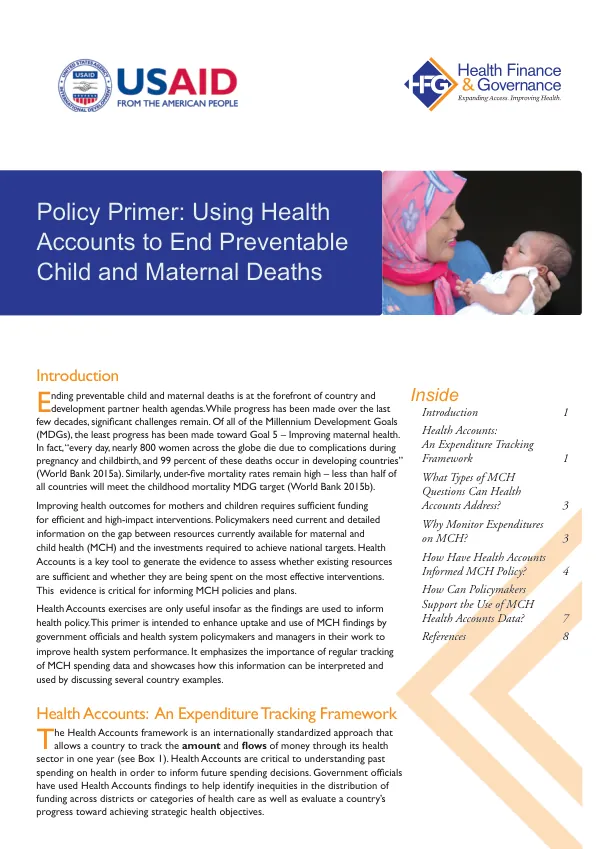
Policy Primer: Using Health Accounts to End Preventable Child and Maternal Deaths
Improving health outcomes for mothers and children requires sufficient funding for efficient and high-impact interventions.
2015 · 8 pages
Sign in to readA free account is required to download.
Abstract
Policymakers need current and detailed information on the gap between resources currently available for maternal and child health (MCH) and the investments required to achieve national targets. Health Accounts is a key tool to generate the evidence to assess whether existing resources are sufficient and whether they are being spent on the most effective interventions. The Health Accounts framework is an internationally standardized approach that allows a country to track the amount and flows of money through its health sector in one year. Health Accounts are critical to understanding past spending on health in order to inform future spending decisions. Government officials have used Health Accounts findings to help identify inequities in the distribution of funding across districts or categories of health care as well as evaluate a country's progress toward achieving strategic health objectives. Health Accounts can also allow policymakers to answer questions about spending on specific health problems or disease areas. Maternal health captures spending during pregnancy, childbirth, and the first six months after delivery. Child health includes all goods and services delivered to the child after birth up to age five whose primary purpose is to restore, improve, or maintain health. Health Accounts estimations can answer questions about spending related to MCH, such as how much is spent on maternal health care, what share of total health expenditure is allocated to child health, and how much does the country rely on donors for maternal health services and commodities. Regular expenditure tracking is recommended by the World Health Organization (WHO) to guarantee the fundamental human right of every woman and child to have access to quality health care. The WHO recommends that countries track health expenditure data on an annual basis. Expenditure tracking enables data-driven decisions, allowing policymakers to assess the level of distribution and resources and how that distribution aligns with health sector priorities.