USAID DEC
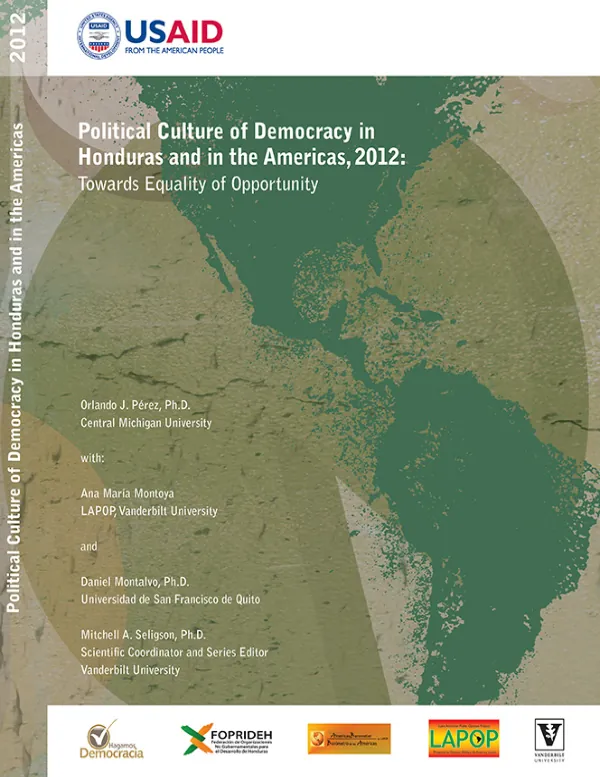
Political Culture of Democracy in Honduras and in the Americas, 2012: Towards the Equality of Opportunity
Sign inLAPOP – VANDERBILT UNIVERSITY
Political Culture of Democracy in Honduras and in the Americas, 2012: Towards the Equality of Opportunity
The study "Political Culture of Democracy in Honduras and in the Americas, 2012: Towards the Equality of Opportunity" was conducted by Orlando J.
2012 · 299 pages
Sign in to readA free account is required to download.
Abstract
Pérez, Ph.D., and his collaborators from Central Michigan University, the Latin American Public Opinion Project, and Universidad de San Francisco de Quito. The study was supported by the Program in Democracy and Governance of the United States Agency for International Development. The study aimed to examine the equality of opportunities and democracy in the Americas, with a focus on Honduras. The researchers used data from the AmericasBarometer, a public opinion survey conducted in 2012. The study analyzed public opinion on various issues, including economic and social opportunities, political participation, and corruption. In Honduras, the study found that 22% of respondents reported being discriminated against, with women and marginalized racial/ethnic groups being more likely to experience discrimination. Public opinion on racial and gender inequalities was also examined, with 64% of respondents agreeing that racial inequalities are a major problem in Honduras. The study also explored public opinion on common public policy proposals, including conditional cash transfers, affirmative action, and compulsory voting. The results showed that 71% of respondents supported compulsory voting, while 55% supported affirmative action. In terms of political participation, the study found that 42% of respondents in Honduras reported voting in the 2012 elections, while 44% reported participating in protests. Public opinion on women's leadership and leadership by marginalized racial/ethnic groups was also examined, with 53% of respondents agreeing that women should have equal opportunities to hold public office. The study also analyzed the impact of unequal opportunities and discrimination on political legitimacy and engagement. The results showed that 68% of respondents believed that inequality is a major problem in Honduras, while 75% believed that corruption is a major problem. In terms of governance, the study found that 91% of respondents in Honduras believed that corruption is a major problem, while 94% believed that crime is a major problem. The study also examined public opinion on the rule of law, with 83% of respondents agreeing that the rule of law is essential for democracy. The study concluded that Honduras faces significant challenges in terms of equality of opportunities, political participation, and corruption. The results of the study highlight the need for policies and programs that promote equality, reduce inequality, and increase political participation. The study also found that local government participation is an important aspect of democracy in Honduras. The researchers analyzed municipal meeting attendance and found that 14% of respondents reported attending municipal meetings in the past year. Overall, the study provides valuable insights into the political culture of democracy in Honduras and the Americas. The results highlight the need for policies and programs that promote equality, reduce inequality, and increase political participation.