SAVE THE CHILDREN FUND
Stakeholder Consultation: RFSA RFA Design and Process
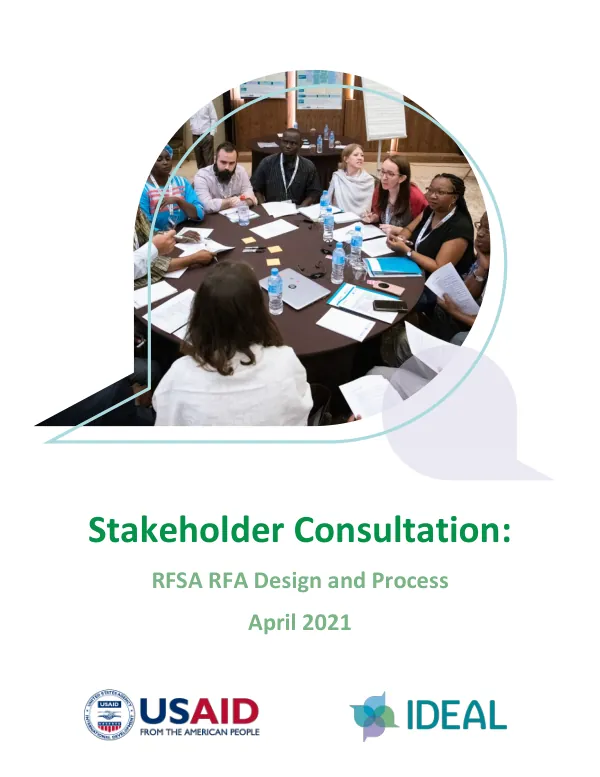
The Stakeholder Consultation on RFSA RFA Design and Process was convened by IDEAL in April 2021, bringing together nearly 40 participants from implementing partners and BHA over two days.
2021 · 18 pages
Sign in to readA free account is required to download.
Abstract
The consultation aimed to provide input into the RFSA solicitation process, improve the clarity of the Request for Applications (RFAs), and lower barriers for non-traditional applicants. The content for this Stakeholder Consultation was informed by implementing partners' input during a qualitative outreach process held prior to the event. IDEAL staff performed interviews with 25 staff from 13 partners and one independent consultant, gathering initial qualitative data on partner experiences with the BHA RFSA RFA design and solicitation process. The interviews explored design elements of RFAs, submission requirements of RFAs, and the solicitation process, acknowledging that aspects of the design and process have varied over the last five years. Nine major themes emerged from the pre-consultation interviews to be discussed further during the Stakeholder Consultation event: Theory of Change, Complexity vs. Focus, Prescriptiveness and Level of Detail, Barriers to Application for New/Non-Historic Partners, RFA Release Timing, Multi-Phased Approach, Key Personnel, Contextual Information, and Proposal Development Burden. These themes were the foundation of the event itself, leading to the overall design of the event as well as the themes for discussion. The Stakeholder Consultation was a highly participatory, interactive exchange between BHA and IPs, providing an opportunity for BHA and IP peer-to-peer dialogue and mutual problem-solving. The event offered a venue for partner and BHA representatives to articulate challenges in a safe learning space and hear challenges faced by others with an open mind. The consultation also provided a space for BHA and IP staff to work together in crafting or refining new, improved approaches to emergency and non-emergency food security activities. The consultation was structured into two half-day sessions, with each session focusing on specific themes and topics. The first session covered Theory of Change, Complexity vs. Focus, and Prescriptiveness and Level of Detail, while the second session focused on Barriers to Application for New/Non-Historic Partners, RFA Release Timing, Multi-Phased Approach, Key Personnel, Contextual Information, and Proposal Development Burden. Throughout the consultation, participants engaged in interactive discussions, sharing their experiences and perspectives on the RFSA RFA design and solicitation process. The event also included presentations and group work, allowing participants to work together to identify solutions to the challenges and barriers faced by implementing partners. The Stakeholder Consultation was a critical step in improving the RFSA solicitation process, and the input and feedback provided by participants will inform future RFSA RFA designs and solicitations. The consultation demonstrated the importance of collaboration and dialogue between BHA and IPs in improving food security programming and identifying solutions to the challenges faced by implementing partners.
Related documents