USAID DEC
Potential contributions to food security from scaling up agroforestry and improved soil and water management practices in Burkina Faso
Sign inSOUTH DAKOTA STATE UNIVERSITY
Potential contributions to food security from scaling up agroforestry and improved soil and water management practices in Burkina Faso
The agricultural development initiative in Burkina Faso has been impacted by land degradation over the last 30 years.
2014 · 35 pages
Sign in to readA free account is required to download.
Abstract
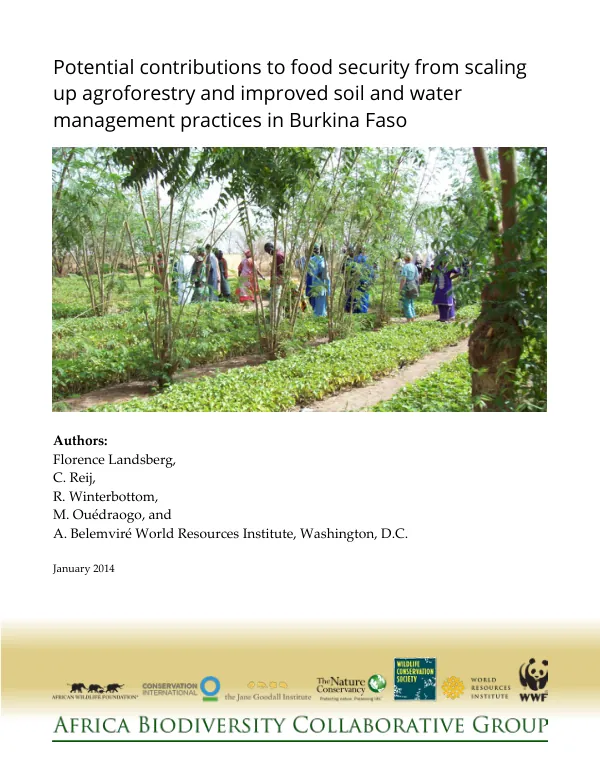
In 2002, 11% of the land was estimated to be "very degraded" and 34% "moderately degraded". However, observations on the ground have demonstrated that with special care, these lands can be reclaimed to support farmers' livelihoods. An increased density of trees in some landscapes has led to an agricultural revival in northern Burkina Faso. Farmers have improved traditional soil and water conservation practices, such as zaï and contour stone bunds, and adopted innovative techniques to restore the productivity of the land. These efforts have slowed down the rate of land degradation by recovering tens of thousands of hectares of degraded land deemed lost to agricultural production. To have decisive gains in agricultural production and productivity at the national level, there is a need to accelerate and scale up the implementation of practices that have been adopted by farmers and proven effective in reclaiming degraded cropland and boosting agricultural productivity. Using GIS analysis, the authors estimate that 4.9 million ha of land are highly suitable for the adoption of zaï, and 7.5 million ha of land are highly suitable for the adoption of agroforestry using farmer-managed natural regeneration. Based on the observed impacts on crop yields by farmers using these practices in Burkina, the widespread adoption of these two improved practices at this scale could contribute an estimated 2.7 million additional tons of cereal each year. The constraints to scaling up these practices have been identified by local, regional, and national actors involved in the promotion of these practices. The challenge most repeatedly identified is that farmers are vulnerable to the usurpation of the fruits of their investment as a result of a weak natural resource rights framework. Land tenure insecurity is a daily challenge for farmers who strive to implement improved soil and water management practices without secure property rights to the land or the trees they have been caring for over the years. The report concludes with several recommendations to address the constraints in the national workshop. The following three overarching recommendations were identified: provide a supportive policy and legal framework with clear property rights to foster implementation of agroforestry and improved soil and water management practices; provide financial support to farmers implementing agroforestry and improved soil and water management practices; and foster a community of practice and build the capacity of farmers, government, and civil society groups. Workshop participants pledged to work together to define and implement a national agroforestry strategy to address key constraints and to support the scaling up. Burkina Faso is a landlocked country in West Africa with an area of 274,200 km2 and a population of more than 16 million people in 2012, of which 80% live in rural areas. Almost half of Burkina's population (46%) is poor, with a significant difference between the rural and urban percentage of people living in poverty at 51% and 16% respectively. Burkina Faso's economy is highly dependent on agriculture, which accounted for 34% of the Gross Domestic Product in 2011. Dominated by small-scale family farms, the sector employs about 85% of the workforce. Forty-three percent of the land area is under some form of agriculture, being primarily rain-fed cropland and a mosaic of land cover used for crops and livestock. Land degradation results from the interaction of various factors, including demographic pressure, inappropriate legal and regulatory frameworks, and agricultural policies and program priorities. Demographic pressure has led to a decrease in the opportunity to regenerate cultivated lands through fallows, particularly on the Central Plateau where population density is high and fallowing land is no longer an option in most areas. Inappropriate legal and regulatory frameworks have resulted in insecure property rights to land and trees, making it difficult for farmers to secure the fruits of their investments in agroforestry, water harvesting, and other forms of improved soil and water management. Agricultural policies and program priorities have promoted the use of inputs, such as mineral fertilizers, which can exacerbate land degradation if not used sustainably.
Related documents