USAID DEC
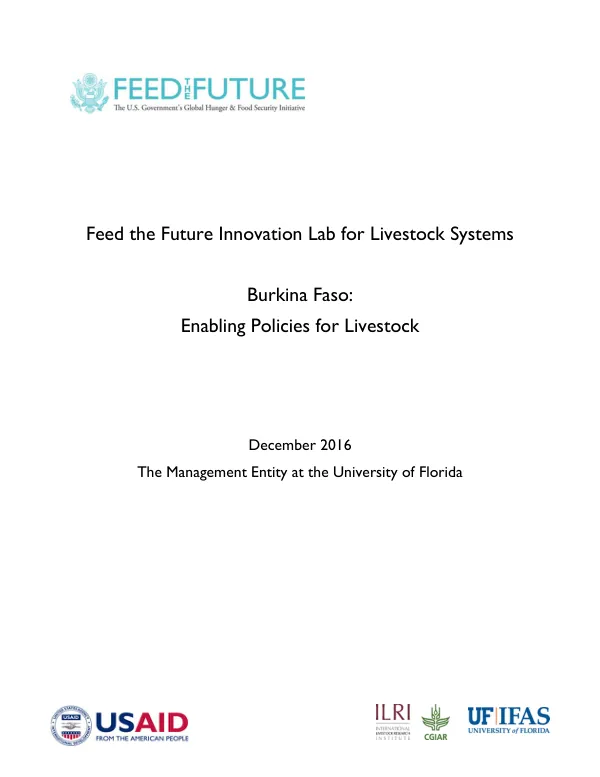
Feed the Future Innovation Lab for Livestock Systems Burkina Faso: Enabling Policies for Livestock Brief
Sign inFLORIDA INTERNATIONAL UNIVERSITY
Feed the Future Innovation Lab for Livestock Systems Burkina Faso: Enabling Policies for Livestock Brief
The National Policy for Lasting Livestock Development (PNDEL) in Burkina Faso was established by the Ministry of Livestock Resources (MRA) for the period 2010-2025.
2016 · 14 pages
Sign in to readA free account is required to download.
Abstract
The policy aims to strengthen the contribution of livestock to national economic growth, promote food and nutrition security, and improve livelihoods. PNDEL's vision is to create a livestock sector that is competitive and respectful of the environment, organized in value chains carried by professional associations, market-oriented, and contributing to food security and improved well-being for the people of Burkina Faso. The policy identifies several constraints affecting the livestock sector, including insufficient market infrastructure, lack of planning capacity, and tenure insecurity. To address these challenges, PNDEL proposes four strategic pillars and priorities in each pillar. The first pillar focuses on building capacity in stakeholders, including reinforcing professional training, technical outreach structures, and professional organizations. The second pillar aims to promote tenure security and the sustainable management of pastoral resources through intensification, sedentarization, and tenure security. The third pillar reinforces the legal framework, supports the creation of Livestock Production Intensification Zones (ZIPAs), and improves water management for livestock. The fourth pillar increases productivity and livestock production, improves food security for livestock, and fights against contagious diseases in extensive production systems. PNDEL also aims to improve competitiveness of animal products and reinforce links between production and markets. The policy includes action plans for cattle/beef, small ruminants, pigs, milk, and traditional aviculture. PNDEL's projections for 2025 are to improve the traditional livestock system to market-oriented semi-intensive or intensive, contributing to national food security and income generation. The policy also aims to create numerous large modern production systems integrated with markets and contributing to income generation and regional trade. Burkina Faso has successfully honored the 2003 ECOWAP/PDDAA Maputo commitment of at least 10% of the public budget dedicated to agriculture and rural sector. The national budget increased from 640 billion CFA to 1,357 billion CFA from 2004-2011, resulting in an average of 10.2% of the national budget dedicated to agriculture. The Ministry of Livestock Resources (MRA) received barely 7% of the agriculture budget, while livestock contributed an estimated 35% of GDP in the primary sector. The Fund for Livestock Development (FODEL) is an important internal financing mechanism established in 1993, which finances micro-projects associated with small producer operating costs. FODEL is funded in part by the Contribution of the Livestock Sector (CSE) tax that is collected by customs agents on livestock exports. The CSE tax has the potential to generate higher revenues, with only 16% of tax collected in 2009 and 33% in 2011. The National Policy for Lasting Livestock Development (PNDEL) is consistent with the Livestock Action Plan (2011-2020) of the Economic Community of West African States (ECOWAS). The policy is also aligned with the national development plan, the Strategic Plan for the National Rural Sector Program (PNSR) 2011-2015, which aims to achieve food and nutrition security, strong economic growth, and poverty reduction.
Related documents