USAID
Poverty Assessment Tools Reporting Requirement
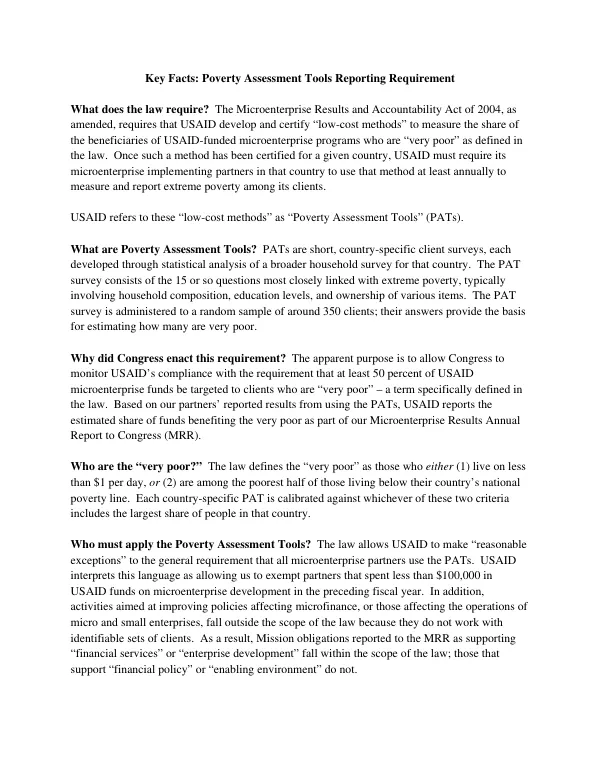
The Microenterprise Results and Accountability Act of 2004 requires USAID to certify "low-cost methods" to measure the share of beneficiaries of USAID-funded microenterprise programs who are "very poor."
2009 · 2 pages
Sign in to readA free account is required to download.
Abstract
These methods are referred to as Poverty Assessment Tools (PATs). The PATs are country-specific client surveys developed through statistical analysis of a broader household survey for that country. The survey consists of 15 or so questions involving household composition, education levels, and ownership of various items. The PAT survey is administered to a random sample of 350 clients, and the results provide the basis for estimating how many are very poor. The purpose of this requirement is to allow Congress to monitor USAID's compliance with the requirement that at least 50 percent of USAID microenterprise funds be allocated to clients who are "very poor." The estimated share of funds allocated to the very poor is reported in the Microenterprise Results Annual Report to Congress. The "very poor" are defined as individuals who live on less than $1 per day or are among the poorest half of those living below their country's national poverty line. Each country-specific PAT is calibrated against the criterion that captures the largest share of people in that country. USAID is allowed to make "reasonable exceptions" to the general requirement that all microenterprise partners use the PATs. Partners that spent less than $100,000 in USAID funds on microenterprise development in the preceding fiscal year are exempt, as well as activities that improve policies affecting micro and small enterprises. The PATs are applied either during or shortly after the fiscal year when USAID funds were spent, and the results are reported no later than the end of the following calendar year. Implementing partners should already have their preparations underway, and those who have received PAT training should be able to implement the full PAT cycle in no more than 8 weeks. Partners without training should begin preparing immediately, using the online training resources available on the Poverty Assessment Tools website. Missions can help by coordinating efforts among partners to share resources and avoid duplicating effort in key aspects of the process. Missions are also responsible for ensuring that USAID enforces this reporting requirement. Implementing partners can access additional information on the Poverty Assessment Tools website, including legislative background, the development process, and FAQs. The PAT Help Desk is also available to answer questions on planning and implementation.
Related documents