POWER AFRICA
POWER AFRICA EAST AFRICA RESULTS AND PRIORITIES
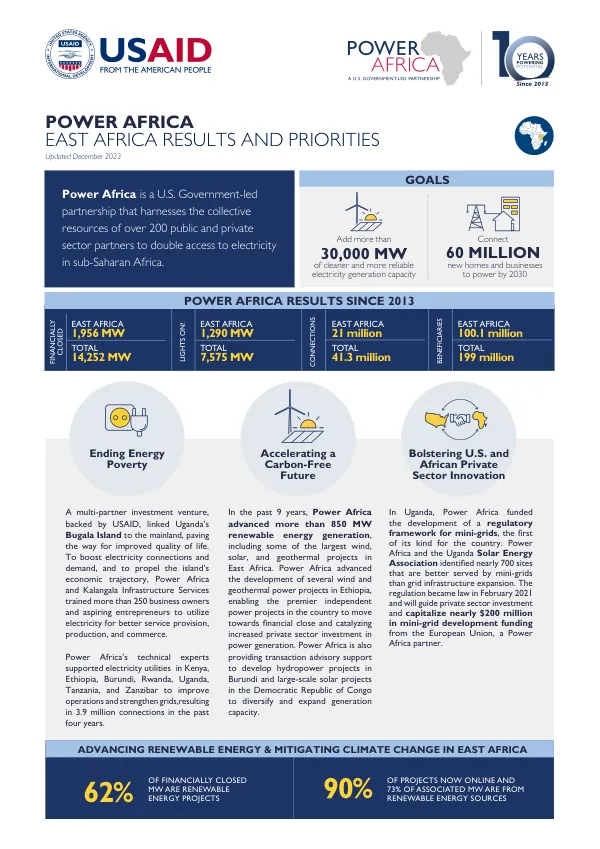
Power Africa is a U.S.
2023 · 2 pages
Sign in to readA free account is required to download.
Abstract
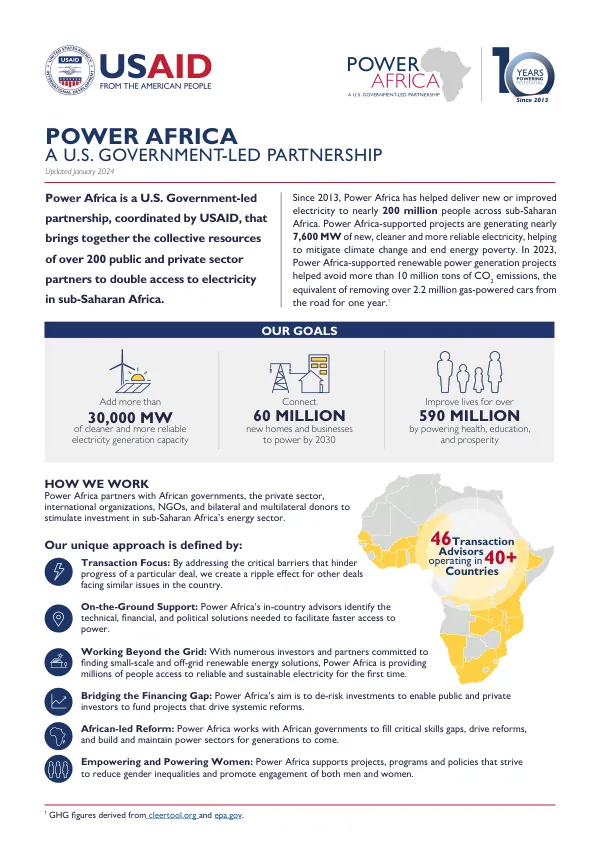
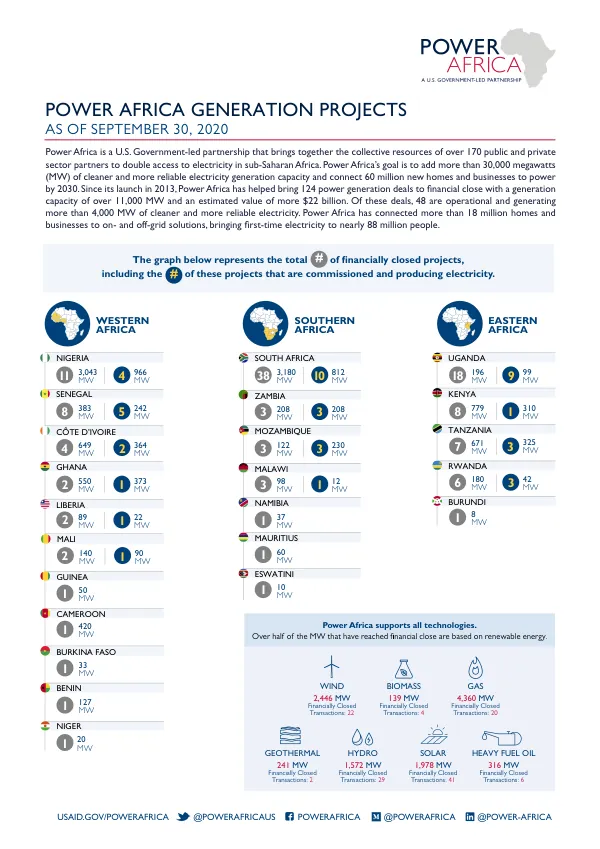
Government-led partnership that aims to double access to electricity in sub-Saharan Africa. The initiative harnesses the collective resources of over 200 public and private sector partners to achieve this goal. Power Africa's objectives include adding more than 30,000 MW of cleaner and more reliable electricity generation capacity and connecting 60 million new homes and businesses to power by 2030. Since its inception in 2013, Power Africa has made significant progress in East Africa. The region has seen a total of 14,252 MW of electricity generation capacity added, with 1,956 MW of this capacity coming from East Africa. In terms of connections, 41.3 million people have been connected to power, with 21 million of these connections made in East Africa. The initiative has also benefited 199 million people, with 100.1 million of these individuals residing in East Africa. Power Africa has implemented various projects to boost electricity connections and demand in the region. In Uganda, the initiative linked Bugala Island to the mainland, paving the way for improved quality of life. Power Africa and Kalangala Infrastructure Services trained over 250 business owners and aspiring entrepreneurs to utilize electricity for better service provision, production, and commerce. The initiative has also supported electricity utilities in Kenya, Ethiopia, Burundi, Rwanda, Uganda, Tanzania, and Zanzibar to improve operations and strengthen grids, resulting in 3.9 million connections in the past four years. Power Africa has also advanced renewable energy generation in East Africa, with over 850 MW of renewable energy capacity added in the past nine years. The initiative has supported the development of several wind, solar, and geothermal projects in the region, including some of the largest projects in East Africa. Power Africa has also provided transaction advisory support to develop hydropower projects in Burundi and large-scale solar projects in the Democratic Republic of Congo to diversify and expand generation capacity. In Uganda, Power Africa funded the development of a regulatory framework for mini-grids, the first of its kind for the country. The regulation became law in February 2021 and will guide private sector investment and capitalize nearly $200 million in mini-grid development funding from the European Union, a Power Africa partner. The initiative has also supported the development of a solar home systems technician program in Rwanda, which has trained over 184 female apprentices and interns, of which 111 have gained employment in the energy sector. Power Africa's generation projects in East Africa include biomass, wind, solar, and hydroelectric power plants. In Uganda, the initiative has supported the development of several biomass and hydroelectric power projects, including the Scoul 2 and Achwa 2 HPP projects. In Kenya, Power Africa has supported the development of several wind and solar power projects, including the Kipeto and Malindi Solar projects. In Rwanda, the initiative has supported the development of several solar and hydroelectric power projects, including the Gigawatt Global Agahozo-Shalom Youth Village Solar Project and the Giciye III hydroelectric power project. Power Africa has also implemented several programs to support its objectives in East Africa. The Energy Program, which ran from 2018 to 2022, had a budget of $65.4 million. The Power Africa Off-Grid Project, which also ran from 2018 to 2022, had a budget of $49.9 million. The Empowering East and Central Africa program, which runs from 2023 to 2028, has a budget of $89 million.