BANK FOR WEST AFRICAN DEVELOPMENT
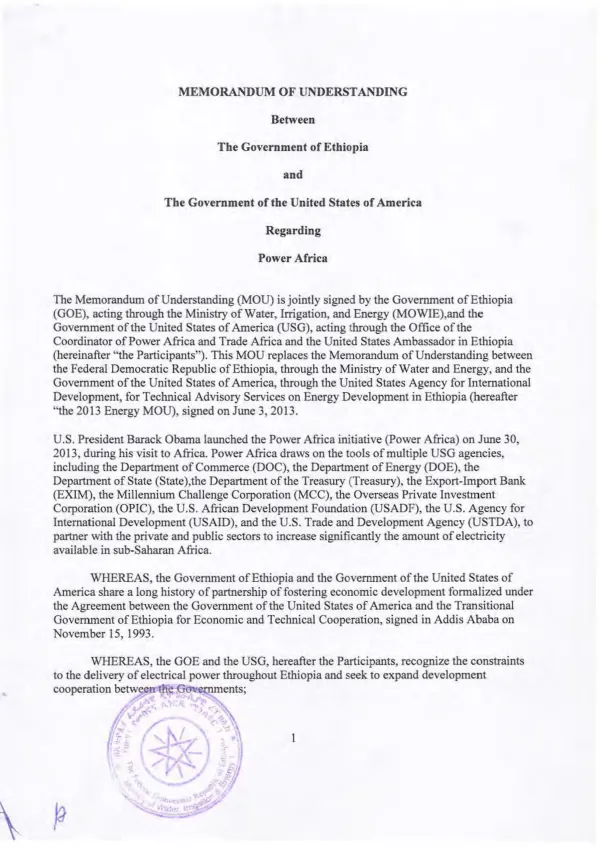
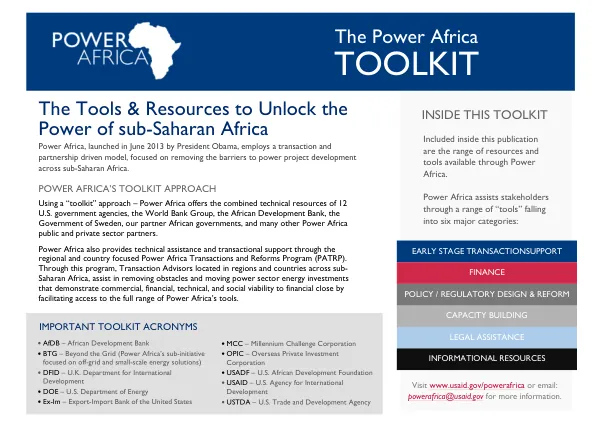
POWER AFRICA Leveraging Partnerships to Increase Access to Power Sub-Saharan Africa
Power Africa is a U.S.
2017 · 2 pages
Sign in to readA free account is required to download.
Abstract
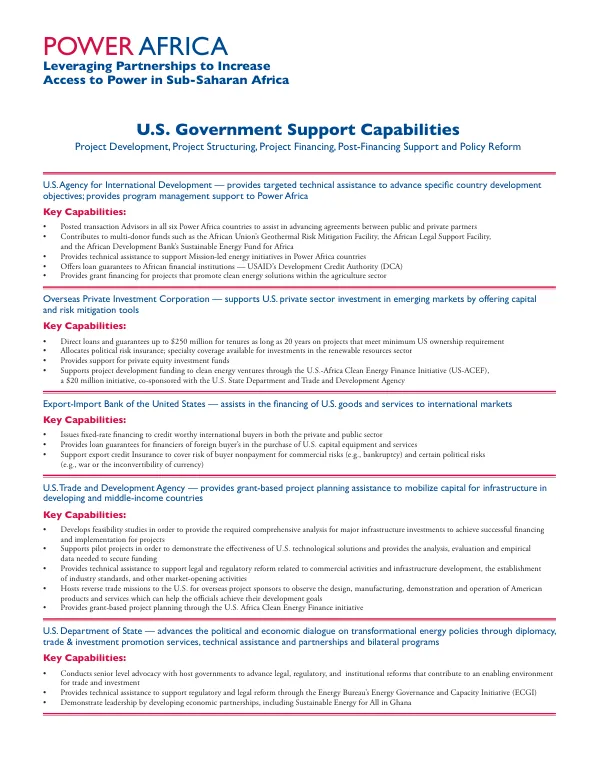
government initiative aimed at increasing access to power in Sub-Saharan Africa. The program leverages partnerships to achieve its objectives, with a focus on promoting clean energy solutions. Key partners include the U.S. Agency for International Development (USAID), the Overseas Private Investment Corporation (OPIC), the Export-Import Bank of the United States, and the U.S. Trade and Development Agency. USAID provides targeted technical assistance to advance specific country development objectives, including the advancement of Power Africa. Key capabilities include transaction advisors in all six Power Africa countries, multi-donor funds, and technical assistance to support Mission-led energy initiatives. USAID also offers loan guarantees to African financial institutions and provides grant funding for projects that promote clean energy solutions within the agriculture sector. OPIC supports U.S. private sector investment in emerging markets, offering capital and risk management tools. Key capabilities include direct loans, political risk insurance, and support for project development funding. OPIC also provides support for clean energy ventures through the U.S.-Africa Clean Energy Finance Initiative. The Export-Import Bank of the United States assists in the financing of U.S. goods and services to international markets. Key capabilities include fixed-rate financing, loan guarantees, and export credit insurance. The bank provides financing to creditworthy international buyers in both the public and private sectors. The U.S. Trade and Development Agency provides grant-based project planning assistance to mobilize capital for infrastructure in developing and middle-income countries. Key capabilities include feasibility studies, pilot projects, technical assistance, and regulatory reform, as well as hosting trade missions to the U.S. for overseas project sponsors. The U.S. Department of State advances the political and economic dialogue on transformational energy policies through diplomacy, investment promotion services, and partnerships. Key capabilities include senior-level advocacy, regulatory reform, and institutional support for sustainable energy in Ghana. The Millennium Challenge Corporation is an independent U.S. aid agency that partners with countries to fund projects that promote economic growth and reduce poverty. Key capabilities include financial support for approved energy infrastructure projects, sector reforms, and governance changes to make the power sector commercially viable. The U.S. Department of Commerce facilitates global trade and strengthens the international economic position of the United States. Key capabilities include market barriers, trade financing, trade data, and methodology to expand international sales and marketing. The U.S. Department of the Treasury works directly with ministries of finance, economy, and budget in target countries to advise on macroeconomic policy decisions, improve the investment climate, and provide financing options for infrastructure. Key capabilities include budget and financial accountability, government debt management, revenue policy administration, and structuring of infrastructure investments and agreements. The U.S. Department of Energy provides technical expertise to U.S. agencies and African countries to improve the efficiency and resilience of energy systems, while reducing adverse environmental impact. Key capabilities include grid development, energy market analysis, policy analysis, and technical assistance for regulatory reform. The U.S. African Development Foundation supports African enterprises, cooperatives, and community-based organizations to build capacity and expand economic activity. Key capabilities include capacity building and expansion grants, due diligence research, and monitoring and evaluation oversight. The U.S. Department of Agriculture promotes sound policies and provides technical assistance to support national and international agriculture, energy, environmental, and trade issues. Key capabilities include policy, regulatory, and institutional capacity building, utility infrastructure, renewable energy, and financing issues. The U.S. Army Corps of Engineers conducts engineering and construction management for power generation projects on a reimbursement basis.
Related documents