BANK FOR WEST AFRICAN DEVELOPMENT
U.S. Overseas Loan and Grants—Foreign Assistance Fast Facts: FY2009
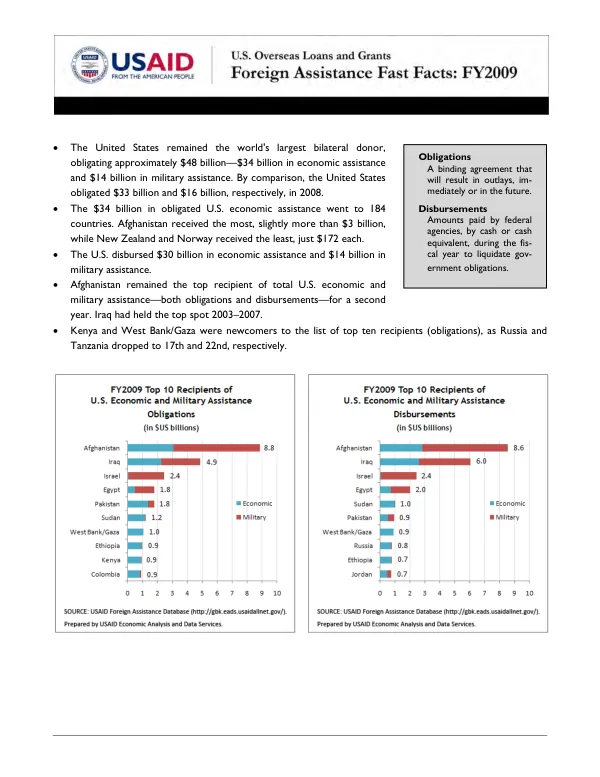
The United States remained the world's largest bilateral donor, obligating approximately $48 billion in foreign assistance during the fiscal year 2009.
2009 · 5 pages
Sign in to readA free account is required to download.
Abstract
This amount consisted of $34 billion in economic assistance and $14 billion in military assistance. In comparison, the United States obligated $33 billion and $16 billion, respectively, in 2008. The $34 billion in obligated U.S. economic assistance was distributed among 184 countries. Afghanistan received the largest share, with slightly more than $3 billion, while New Zealand and Norway received the least, with just $172 each. The U.S. disbursed $30 billion in economic assistance and $14 billion in military assistance during the fiscal year 2009. Afghanistan remained the top recipient of total U.S. economic and military assistance, both in obligations and disbursements, for a second consecutive year. Iraq had held the top spot from 2003 to 2007. Kenya and the West Bank/Gaza were new additions to the list of top ten recipients, while Russia and Tanzania dropped to 17th and 22nd, respectively. Nineteen U.S. government agencies funded foreign assistance activities during the fiscal year 2009. The five primary agencies providing bilateral foreign assistance were the U.S. Agency for International Development (USAID), the State Department, the U.S. Department of Agriculture (USDA), the Department of Defense (DoD), and the Millennium Challenge Corporation (MCC). These five agencies accounted for approximately 88 percent of total economic assistance obligations. The distribution of U.S. economic assistance by region showed that Sub-Saharan Africa received the largest share, with 29 percent of the total. Of the 48 countries that received over $100 million in economic assistance, 22 were in Sub-Saharan Africa. The top five recipients of U.S. economic assistance by region were Afghanistan, Pakistan, Indonesia, Bangladesh, and the Philippines in Asia; Georgia, Russia, Serbia, Ukraine, and Kazakhstan in Europe and Eurasia; Colombia, Mexico, Haiti, Peru, and El Salvador in Latin America and the Caribbean; Iraq, West Bank/Gaza, Jordan, Egypt, and Morocco in the Middle East and North Africa; and Sudan, Ethiopia, Kenya, South Africa, and Burkina Faso in Sub-Saharan Africa. The distribution of U.S. economic assistance by World Bank income group showed that lower-middle income countries received almost a third of all U.S. economic assistance, more than any other group. The top five recipients of U.S. economic assistance by income group were Afghanistan, Ethiopia, Kenya, Burkina Faso, and Uganda in the low-income category; Iraq, Pakistan, Sudan, West Bank/Gaza, and Georgia in the low-middle income category; Colombia, South Africa, Mexico, Namibia, and Russia in the upper-middle income category; and Israel, Poland, Ireland, Canada, and the Bahamas in the high-income category. The U.S. government and multilateral organizations, such as the World Bank, United Nations, and World Trade Organization, implemented roughly 60 percent of total U.S. economic assistance through contracts or other binding agreements with implementing partners.
Related documents