BANK FOR WEST AFRICAN DEVELOPMENT
Power Africa Toolkit
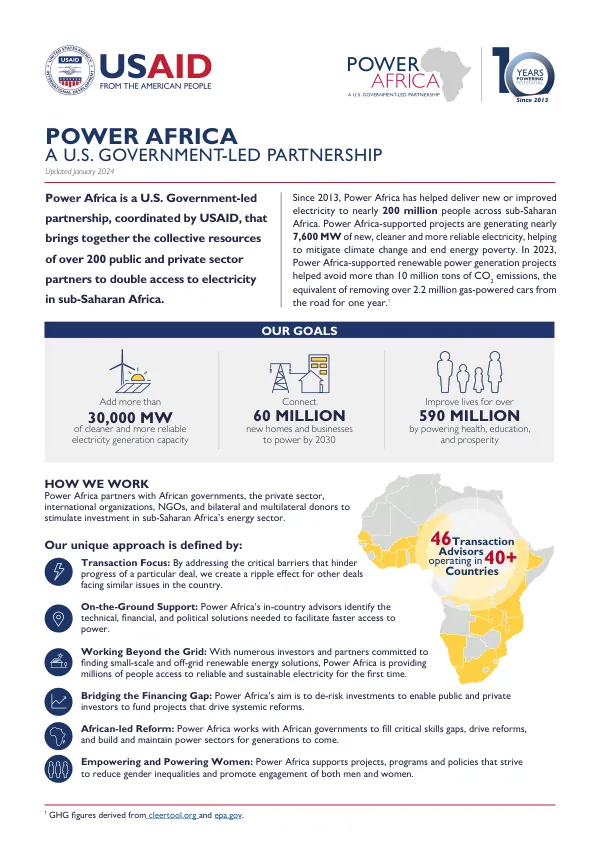
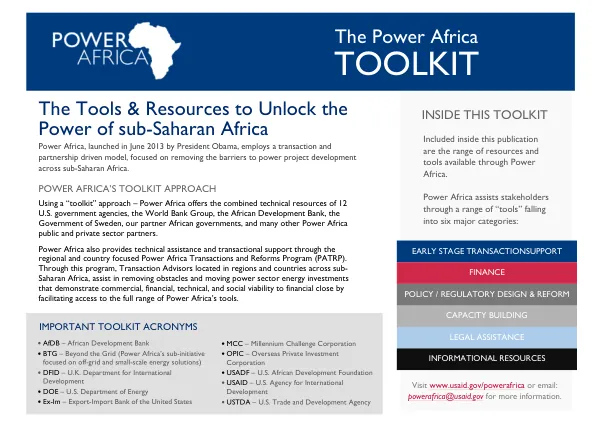
Power Africa, launched in June 2013 by President Obama, employs a transaction and partnership-driven model to remove barriers to power project development across sub-Saharan Africa.
2015 · 6 pages
Sign in to readA free account is required to download.
Abstract
The initiative uses a "toolkit" approach, combining the technical resources of 12 U.S. government agencies, the World Bank Group, the African Development Bank, the Government of Sweden, and other Power Africa public and private sector partners. Power Africa provides technical assistance and transactional support through the regional and country-focused Power Africa Transactions and Reforms Program (PATRP). Transaction Advisors located in regions and countries across sub-Saharan Africa assist in removing obstacles and moving power sector energy investments to financial close by facilitating access to the full range of Power Africa's tools. The toolkit includes six major categories of resources and tools, each falling under a specific mechanism, agency, or organization. These categories include AfDB, BTG, DFID, DOE, Ex-Im, MCC, OPIC, USADF, and USAID. Each tool is described, along with its purpose, eligibility requirements, and location-specific details. For example, the Africa Renewable Energy Fund (AREF) provides equity investments for small-to-medium renewable energy projects, while the Development Credit Authority (DCA) offers partial-credit guarantees to mobilize commercial debt capital. The Direct Loans program provides long-term fixed-rate financing to purchase U.S. capital equipment and services, and the Direct Loans & Investment Guaranties program offers financing products for projects in countries where conventional lenders are reluctant. In addition to these tools, Power Africa also provides finance-related resources, including the Clean Energy Ministerial Clean Energy Solutions Center (CESC), which offers energy sector policy analysis and resources to government ministries and policymakers. The CESC also provides webinars on policy design, best practices, and lessons-learned, as well as an "Ask-an-Expert" service providing international expert assistance on clean energy issues. The initiative also includes the Clean Energy Ministerial Global Lighting & Energy Access Partnership (LEAP), which provides resources and tools for clean energy and energy efficiency suppliers, consumers, policymakers, and other stakeholders. The Delivery Units program provides targeted support in developing intra-governmental working groups to resolve critical challenges, while the East Africa Regional Regulatory Partnership offers capacity building to assist energy regulators in East Africa on regional electricity trade. Overall, Power Africa's toolkit approach provides a range of resources and tools to support power project development across sub-Saharan Africa, with a focus on removing barriers and facilitating access to finance.