POWER AFRICA
POWER AFRICA SUPPORTING SOUTH AFRICA'S JUST ENERGY TRANSITION
South Africa's Just Energy Transition (JET) is a critical component of the country's efforts to enhance energy security and reliability while mitigating the impacts of climate change, reducing dependence on fossil fuels, and promoting sustainable economic growth and development.
2023 · 2 pages
Sign in to readA free account is required to download.
Abstract
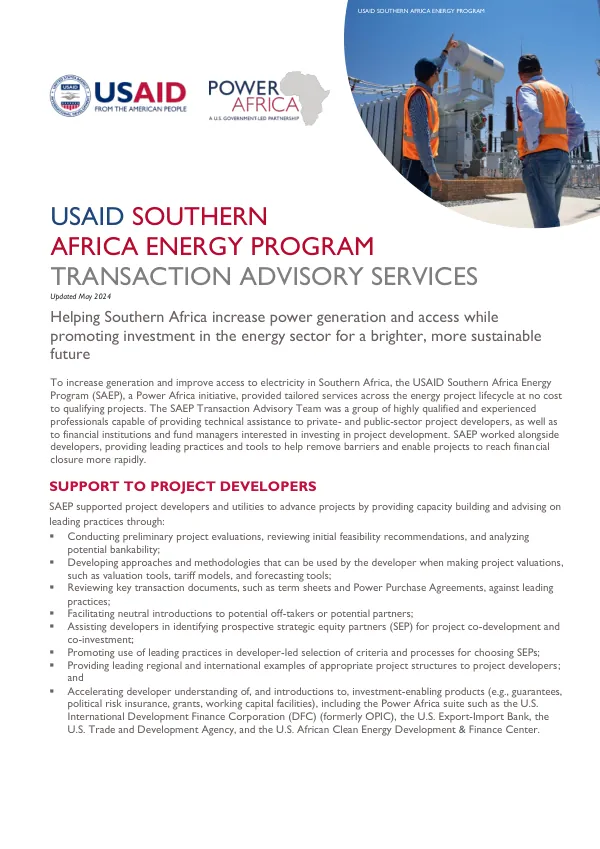
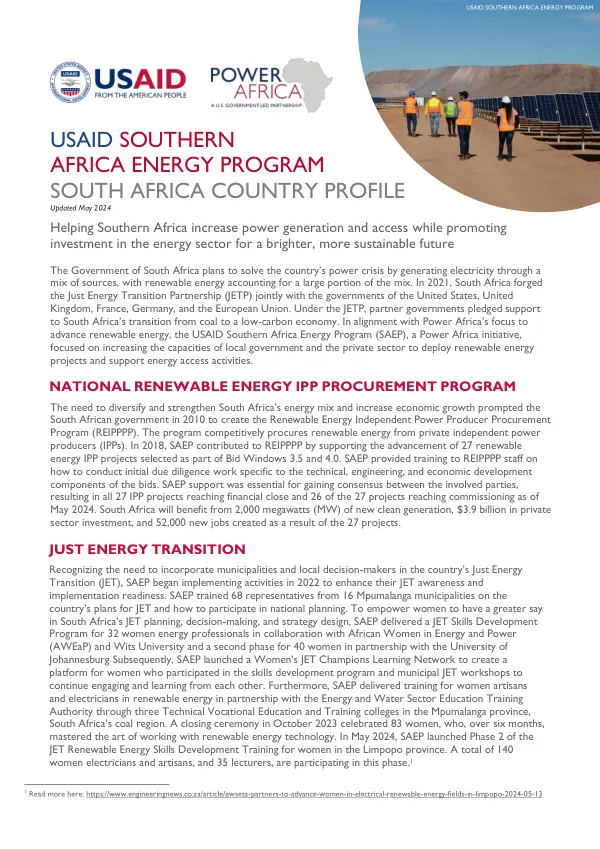
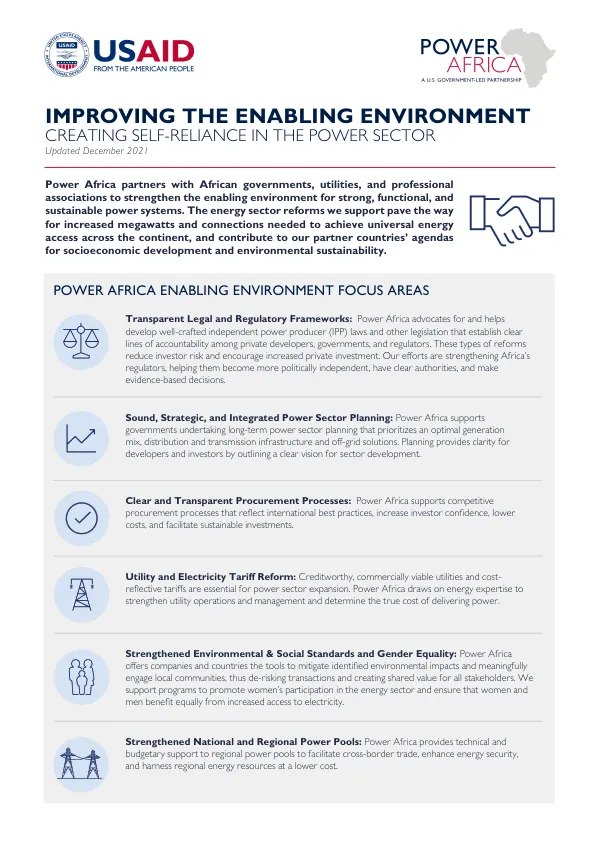
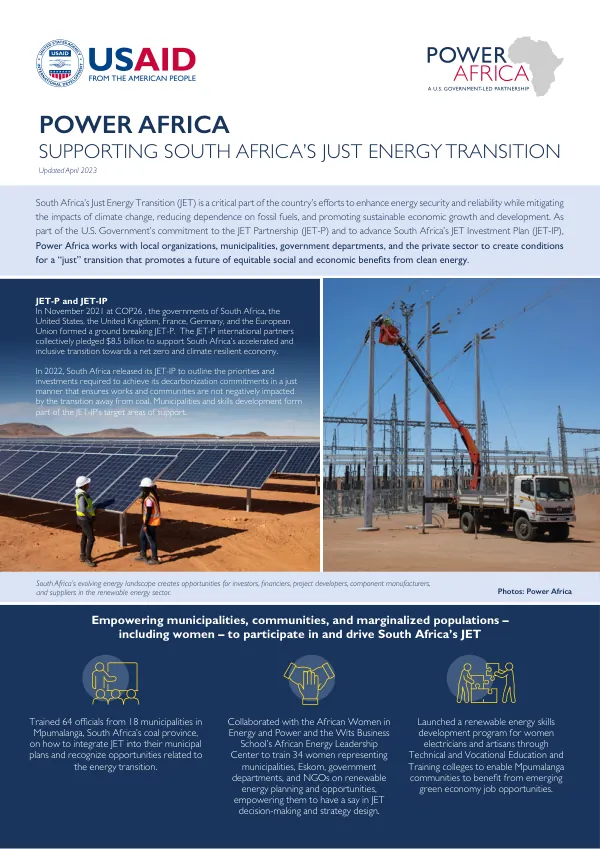
As part of the U.S. Government's commitment to the JET Partnership (JET-P) and to advance South Africa's JET Investment Plan (JET-IP), Power Africa works with local organizations, municipalities, government departments, and the private sector to create conditions for a "just" transition that promotes a future of equitable social and economic benefits from clean energy. In November 2021, the governments of South Africa, the United States, the United Kingdom, France, Germany, and the European Union formed the JET-P, collectively pledging $8.5 billion to support South Africa's accelerated and inclusive transition towards a net zero and climate resilient economy. In 2022, South Africa released its JET-IP to outline the priorities and investments required to achieve its decarbonization commitments in a just manner that ensures workers and communities are not negatively impacted by the transition away from coal. Municipalities and skills development form part of the JET-IP's target areas of support. Power Africa has been actively involved in supporting South Africa's JET, with a focus on empowering municipalities, communities, and marginalized populations, including women, to participate in and drive the transition. The organization has trained 64 officials from 18 municipalities in Mpumalanga, South Africa's coal province, on how to integrate JET into their municipal plans and recognize opportunities related to the energy transition. Additionally, Power Africa has collaborated with the African Women in Energy and Power and the Wits Business School's African Energy Leadership Center to train 34 women representing municipalities, Eskom, government departments, and NGOs on renewable energy planning and opportunities, empowering them to have a say in JET decision-making and strategy design. Power Africa has also launched a renewable energy skills development program for women electricians and artisans through Technical and Vocational Education and Training colleges to enable Mpumalanga communities to benefit from emerging green economy job opportunities. Furthermore, the organization has improved municipal capacity to invest in and plan for renewable energy power projects and increase electricity access through institutional and human resource capacity building, customized revenue management support, early-stage energy planning, and advanced-stage energy planning. Power Africa has also addressed critical planning and implementation barriers to reaching electrification targets, with one municipality receiving funding to electrify an informal settlement, which will increase access to electricity for 1,050 households. Power Africa is also advancing national planning to develop renewable energy power and electrification infrastructure by supporting the Department of Mineral Resources and Energy and its service providers to complete provincial electrification plans to drive funding allocations for municipal electrification projects. Additionally, the organization is collaborating with the Council for Scientific and Industrial Research to develop a center of excellence for developing microgrids intended to assist Eskom and other municipalities increase access and improve reliability. Power Africa is providing transaction advisory for renewable and clean energy projects, including technical advisory and financial modeling support to the City of Cape Town to secure supply from independent power producers and assisting the city to develop 270 MW of solar projects.