USAID
Power Distribution Program
Pakistan's energy crisis is alleviated through the Power Distribution Program, which aims to improve the operational and financial performance of the country's nine government-owned electric power distribution companies.
2012 · 2 pages
Sign in to readA free account is required to download.
Abstract
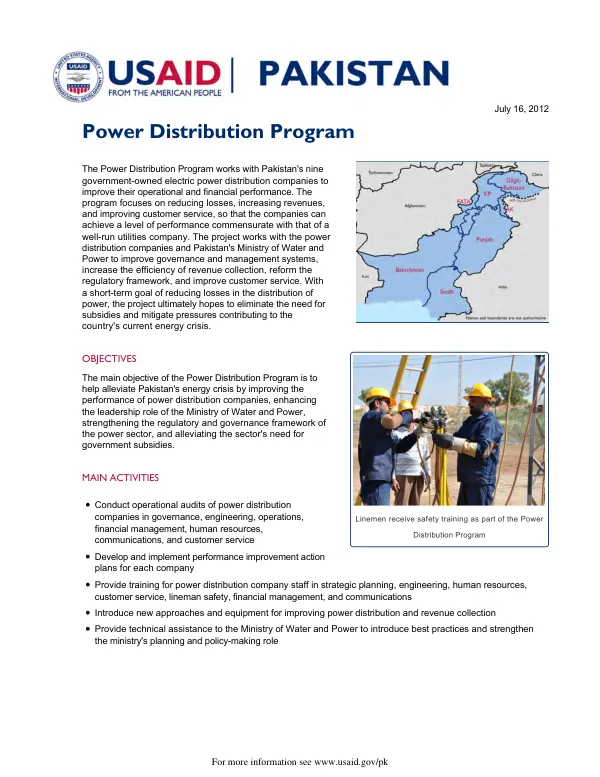
The program focuses on reducing losses, increasing revenues, and improving customer service to achieve a level of performance comparable to that of a well-run utilities company. The program works with power distribution companies and Pakistan's Ministry of Water and Power to improve governance and management systems, increase the efficiency of revenue collection, reform the regulatory framework, and improve customer service. Operational audits of power distribution companies are conducted to identify areas for improvement. The results of these audits are presented to each company, along with a performance action plan to address the identified issues. Training is provided to more than 2,100 power distribution company staff in the implementation of the performance action plan. The Ministry of Water and Power is supported to improve governance and regulation of the country's power sector, develop a National Power Plan, and introduce best practices in performance measurement. The program has achieved several key accomplishments. Capacitors have been installed to reduce the demand for electricity, resulting in a reduction of 17.7 million kilowatt hours of electricity. Capacitor banks have been installed, reducing demand by 47 megawatts and valued at $18.3 million annually. Faulty meters have been replaced, resulting in an overall loss reduction of 8.4 percent, valued at $328,000 annually. A consumer censuses program has been initiated to identify the location of illegal connections and legal connections not properly billed. The program has also provided training to power distribution company staff in strategic planning, engineering, human resources, customer service, lineman safety, financial management, and communications. New approaches and equipment have been introduced to improve power distribution and revenue collection. Technical assistance has been provided to the Ministry of Water and Power to introduce best practices and strengthen the ministry's planning and policymaking role. The program has also provided training to women employees of the power distribution companies for the first time, and governance training has been provided to 117 power distribution company board members. The program has made significant progress in reducing losses and improving the operational and financial performance of the power distribution companies. The results of the operational audits have been presented to each company, and performance action plans have been implemented. The program has also provided training to more than 2,100 power distribution company staff and supported the Ministry of Water and Power in improving governance and regulation of the power sector.
Related documents