UNITED STATES PHARMACOPEIA
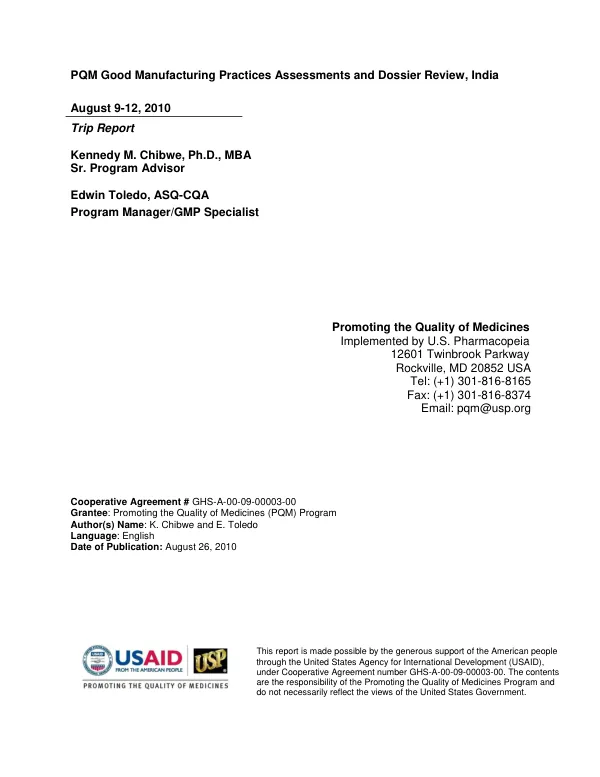
PQM Good Manufacturing Practices Assessments and Dossier Review, India
The Promoting the Quality of Medicines (PQM) program, funded by the U.S.
2010 · 10 pages
Sign in to readA free account is required to download.
Abstract
Agency for International Development (USAID), is the successor of the Drug Quality and Information (DQI) program implemented by the United States Pharmacopeia (USP). PQM is USAID's response to the growing challenge posed by the proliferation of counterfeit and substandard medicines. By providing technical leadership to developing countries, PQM is helping to build local capacity in medicine quality assurance systems, increase the supply of quality medicines to priority USAID health programs, and ensure the quality and safety of medicines globally. Tuberculosis (TB) is a global concern, and PQM has actively contributed to the USAID strategic objective of "increased use of effective interventions to reduce the threat of infectious diseases, including tuberculosis." For example, at the request of USAID and the World Health Organization (WHO), USP developed pharmacopeial analytical methods for testing a fixed-dose combination (FDC) tablet containing rifampicin, isoniazid, ethambutol, and pyrazinamide. This FDC is important in implementing the directly-observed treatment, short-course (DOTS), the internationally recognized strategy to control TB. PQM assists countries to implement anti-TB medicine quality monitoring, and in 2008, began providing technical assistance to interested companies on the preparation of medicine dossiers they submit to WHO with their "Expressions of Interest" for the WHO Prequalification Programme. The PQM team conducted a Good Manufacturing Practices (GMP) assessment audit of the Svizera Labs Private Ltd. facilities in India to assess their compliance with the WHO GMP main principles for pharmaceutical products. The assessment revealed that the Svizera Labs facility is operating in a state of control regarding compliance with the WHO Good Manufacturing Practices for pharmaceuticals. However, minor objectionable observations were noted regarding compliance with the WHO cGMPs for finished pharmaceutical products. These observations applied to the Quality System, Facilities and Equipment System, and Laboratory System. The assessment audit covered the following systems: Quality System, Facilities and Equipment System, Materials System, Production System, Packaging and Labeling System, and Laboratory Control System. The audit revealed that Svizera has systems in place as well as the capabilities, facilities, infrastructure, knowledge, and skills necessary to manufacture finished TB pharmaceutical products. However, the audits also revealed that Svizera has minor objectionable observations regarding compliance with the WHO cGMPs for finished pharmaceutical products. The PQM team also met with Lupin and Cipla to discuss current and future collaborations and PQM technical assistance. The team visited Lupin Ltd. on August 11, 2010, to discuss the Capreomycin 1000 mg powder for injection, and the PQM team visited Cipla on August 12, 2010, to discuss the Cipla's TB product portfolio. The PQM team reviewed Svizera dossiers that are in different stages of completion, focusing on the Ethionamide 250 mg tablets dossier that will be finalized and submitted to WHO before September 2010. The other dossiers will be submitted after completing activities regarding bioequivalence studies. The assessment audit revealed that Svizera has minor objectionable observations regarding compliance with the WHO cGMPs for finished pharmaceutical products. These observations applied to the Quality System, Facilities and Equipment System, and Laboratory System.
Related documents
Documents in this collection
 2015
2015USAID DEC
High Rates of Ofloxacin Resistance in Mycobacterium tuberculosis among Both New and Previously Treated Patients in Tamil Nadu, South India
Open record 2015
2015USAID DEC