DAI GLOBAL, LLC
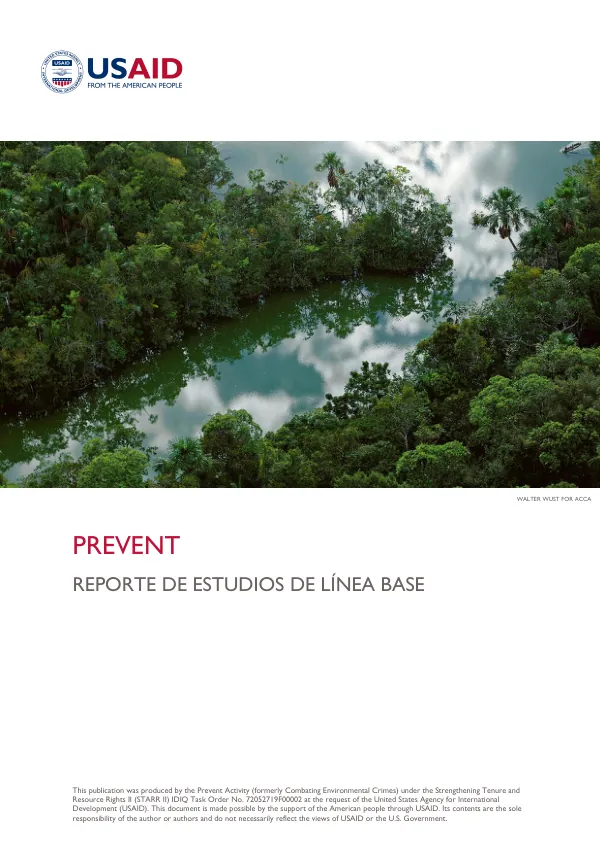
Prevent - Reporte de Línea Base
The Prevent Activity, formerly Combating Environmental Crimes, is a USAID-funded initiative aimed at improving conditions for preventing and combating environmental crimes in the Peruvian Amazon.
2020 · 75 pages
Sign in to readA free account is required to download.
Abstract
The activity is implemented by DAI Global, LLC, and supports the Government of Peru, civil society, and the private sector in their efforts to address environmental crimes. The objectives of the Prevent Activity are to improve enabling conditions for the prevention and combat of environmental crimes, reduce and prevent environmental crime activity within protected areas, their buffer zones, and indigenous lands, and create associations to mobilize resources in support of environmental crime prevention and reduction. Additionally, the activity aims to improve operational conditions and competitiveness of artisanal and small-scale gold mining (MAPE aurífera) through the adoption of environmental and social safeguards. The Prevent Activity is part of the USAID/Peru Amazonía Verde project, which aims to conserve biodiversity, forests, and ecosystem services in priority areas of the Peruvian Amazon. The activity has a multisectoral and integral approach, including the strengthening of the justice system, the use of science and technology, monitoring and protection of flora and fauna, analysis of costs and proposal of economic incentives, inclusion of environmental and social safeguards in the formalization process of artisanal and small-scale mining, and implementation of awareness and information campaigns for citizens. A baseline study or line base is the first measurement of an indicator contemplated in the Activity Monitoring, Evaluation and Learning Plan (AMELP) and allows knowing the value of the indicator at the time of initiating the planned actions; that is, it establishes the "starting point" in the intervention of the Prevent Activity. A baseline study has a quantitative character and can recur to both primary (produced ad hoc) and secondary (previous studies) sources. The activity has given priority to the collection of data for those indicators that require a baseline to establish subsequent comparisons and to investigate the changes that occur as the activity is implemented. The methodology used for each baseline study is specific to the indicator and may involve quantitative, qualitative, or mixed approaches. Data from government organizations and, when necessary, non-governmental sources have been used. In some cases, primary data collection has been conducted, and the process of planning and developing instruments/protocols for data collection has been defined. The Prevent Activity has identified several indicators to measure its progress, including the number of hectares of biologically significant areas under improved natural resource management, the number of formal charges presented against environmental crime offenders, the number of people trained in prevention, monitoring, and combat of environmental crimes, the number of reports on illegal activities detected using new or improved monitoring tools, and the number of media reports on topics related to environmental crime prevention and combat. The baseline studies for these indicators have been conducted, and the results are presented in this report. The studies describe the context in which the Prevent Activity is developed before its implementation. The report provides a comprehensive overview of the baseline studies, including the methodology used, the data collected, and the results obtained. The baseline studies have been conducted for the following indicators: * PRE01 (EG.10.2-2): Number of hectares of biologically significant areas under improved natural resource management as a result of USG assistance. * PRE02C: Number of formal charges presented against environmental crime offenders. * PRE04 (EG.10.2-4): Number of people trained in prevention, monitoring, and combat of environmental crimes. * PRE09C: Number of reports on illegal activities detected using new or improved monitoring tools. * PRE12C: Number of media reports on topics related to environmental crime prevention and combat. The results of the baseline studies provide a comprehensive understanding of the context in which the Prevent Activity is developed and will serve as a reference point for future evaluations and assessments of the activity's progress.