USAID
Private Sector Engagement_GFSS-R Activity Design
The U.S.
2023 · 11 pages
Sign in to readA free account is required to download.
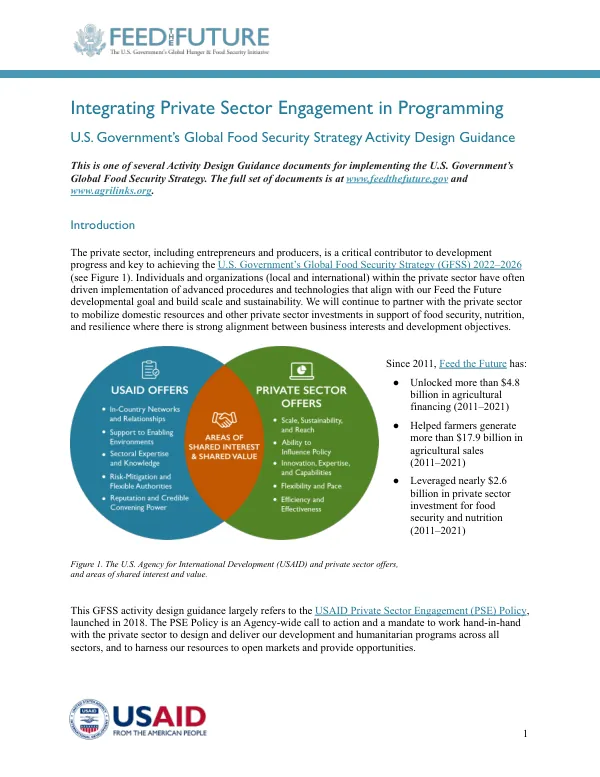
Abstract
Government's Global Food Security Strategy (GFSS) emphasizes the critical role of the private sector in achieving development progress and food security. Private sector engagement is a strategic approach to planning and programming that involves consulting, strategizing, collaborating, and implementing with the private sector to achieve greater scale, sustainability, and effectiveness of outcomes. The GFSS 2022-2026 highlights the importance of lasting partnerships with the private sector, which can leverage unique core capacities and resources such as financial contributions, donated services or property, advancements in science and technology, and intellectual property. Inclusive agricultural and food systems value chain development partnerships can help small-scale producers, especially women, gain greater access to inputs, skills, resource management capacity, networking, bargaining power, financing, and market connections needed to sustain their long-term economic prosperity. The private sector, as defined by the USAID Private Sector Engagement (PSE) Policy, includes for-profit, commercial entities and their affiliated foundations, financial institutions, investors, and intermediaries, business associations and cooperatives, micro, small, medium, and large enterprises that operate in the formal and informal sectors, U.S., local, regional, and multinational businesses, and for-profit approaches that generate sustainable income. Private sector engagement involves a strategic approach to planning and programming that involves consulting, strategizing, collaborating, and implementing with the private sector to achieve greater scale, sustainability, and effectiveness of outcomes. Partnerships, as defined in the GFSS, are efforts to leverage complementary resources and expertise and support capacity development with the private sector, other donors, producer organizations, cooperatives, civil society, faith-based organizations, and agricultural research and academic institutions. Co-creation, as defined on the PSE Co-Creation Guidance webpage, is any purposeful and intentional communication in which USAID and one or more partners jointly determine whether and how they can work together to achieve a mutually valued outcome. This shared decision-making is the most important defining characteristic of the communication and design that takes place under co-creation. Designing activities that integrate private sector engagement requires starting early and engaging often. USAID should reach out to private sector companies and other market actors at the earliest stages of designing GFSS activities and interventions. Early engagement helps to jointly identify a problem, market inefficiency, or gap, source a broad and diverse range of ideas or possible solutions, increase awareness of possible distortive effects or risks, solicit buy-in for U.S. Government-led intervention, and increase understanding of what other market-led resources may be brought to bear. Examples of early engagement include informal, face-to-face, and gender-inclusive discussions with private sector representatives and other market actors, structured, roundtable discussions with key market actors, circulating early-stage concepts and design notes for private sector input and feedback, and open calls for ideas and analyses with targeted private sector actors. Integrating private sector engagement in the program cycle better positions USAID to identify market-based approaches, mobilize private sector investment and expertise, and make more catalytic use of USAID's resources. This involves adapting continuously to new evidence, opportunities, or circumstances and leveraging the private sector's unique core capacities and resources to achieve greater scale, sustainability, and effectiveness of outcomes.
Related documents
Documents in this collection
 2018
2018USAID DEC
Nine Questions Every Company Should Ask to Strengthen their Private Sector Engagement with USAID
Open record
USAID DEC
Design, Implementation, Monitoring, and Evaluation of Cross-Cultural HIV-Related Mental Health and Psychosocial Assistance Programs: A User’s Manual for Researchers and Program Implementers (Adult Version)
Open record