FAMILY HEALTH INTERNATIONAL
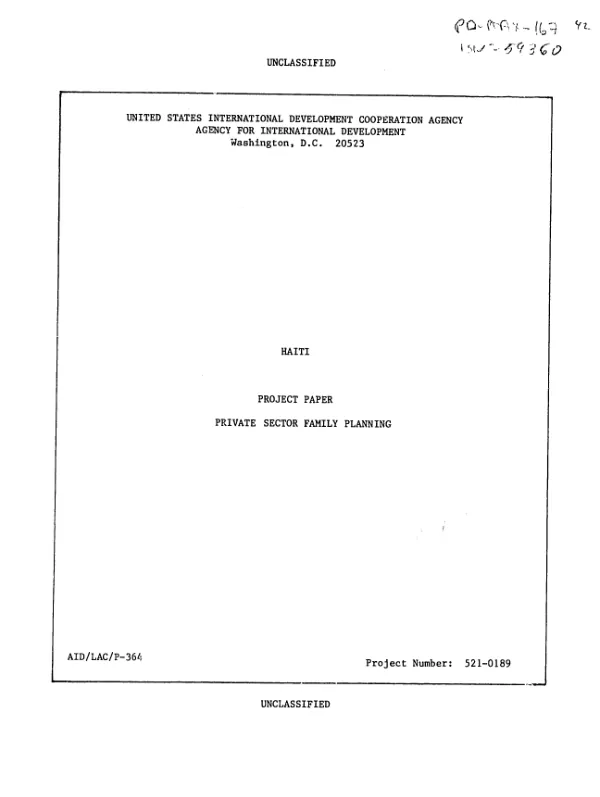
Private Sector Family Planning Project in Haiti
The Private Sector Family Planning Project in Haiti aims to increase the availability and effectiveness of family planning service delivery.
2010 · 98 pages
Sign in to readA free account is required to download.
Abstract
The project involves a cooperative agreement with a U.S.-based non-profit organization to enhance the capability of private sector institutions to provide and promote family planning services. The recipient will execute contracts with indigenous non-governmental organizations to implement the project. Implementation of the project will focus on three key interventions: (1) procurement of contraceptives through AID's central purchasing, (2) provision of goods and services financed by AID under the cooperative agreement, and (3) community-based family planning programs. The project will also involve training and capacity-building activities for private sector institutions and community-based organizations. The project's goal is to increase the availability and effectiveness of family planning services in Haiti, particularly in rural areas where access to such services is limited. The project will target women of reproductive age, with a focus on those in rural areas and those who are most in need of family planning services. The project's methodology will involve a combination of community-based and institutional approaches. Community-based programs will be implemented through partnerships with local organizations, while institutional programs will be implemented through partnerships with private sector institutions. The project will also involve research and evaluation activities to assess the effectiveness of the project and identify areas for improvement. The project's geographic focus is Haiti, with a particular emphasis on rural areas where access to family planning services is limited. The project's timeframes are three years, with the initial obligation date set for August 1986. The project's estimated cost is $3,250,000, with grant funding provided by AID. The project's expected outcomes include increased access to family planning services, particularly in rural areas, and improved reproductive health outcomes for women of reproductive age. The project's expected impact includes a reduction in population growth rates and improved economic and social development outcomes for Haiti. The project's implementation will involve a range of activities, including training and capacity-building programs for private sector institutions and community-based organizations, procurement of contraceptives, and community-based family planning programs. The project will also involve research and evaluation activities to assess the effectiveness of the project and identify areas for improvement. The project's social analysis indicates that Haiti is one of the most densely populated countries in the world, with a rapidly growing population that is putting pressure on the country's already limited resources. The current ratio of population to arable land is seriously exceeding the country's carrying capacity, leading to deforestation, erosion, and soil degradation. The project's analysis also indicates that the demand for family planning services far exceeds the available supply, with many women lacking access to modern contraceptive methods. The project's recommendations include the approval of the project design for a total cost of $3,250,000 in grant funding over a three-year period. The project's summary highlights the need for a comprehensive approach to family planning service delivery in Haiti, including community-based and institutional programs, as well as research and evaluation activities to assess the effectiveness of the project.