ABT ASSOCIATES
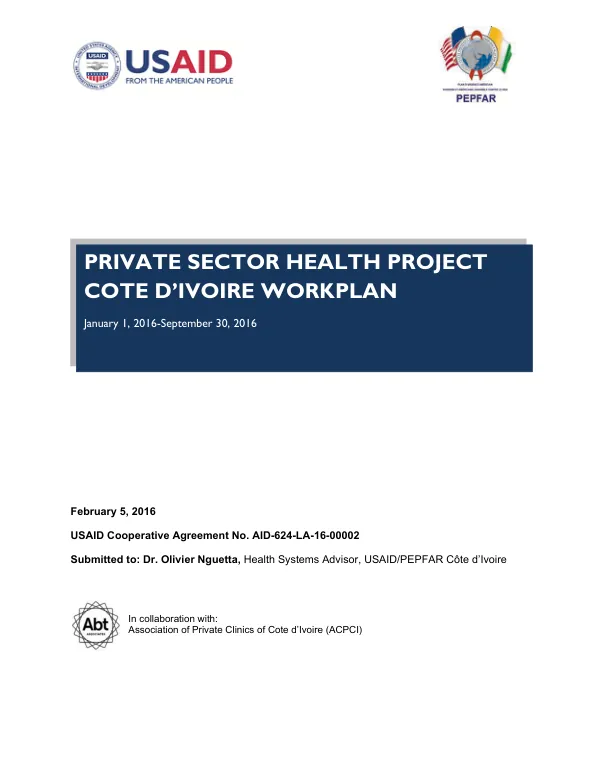
Private Sector Health Project (PSHP) Workplan for Year One in Cote d'Ivoire
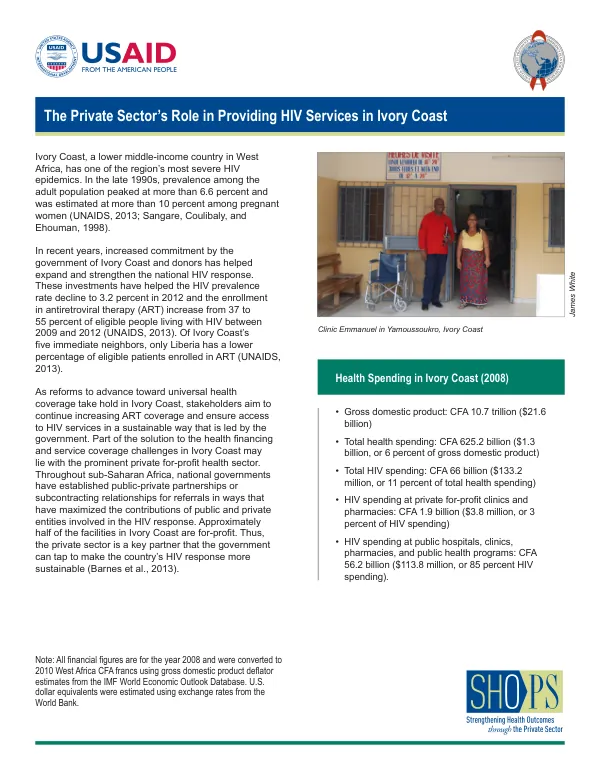
The Private Sector Health Project (PSHP) in Côte d'Ivoire aims to expand access to and ensure the provision of high-quality, integrated HIV and family planning (FP) services in the private sector.
2016 · 17 pages
Sign in to readA free account is required to download.
Abstract
The project is a one-year initiative, covering the period from January to September 2016, and is funded through Cooperative Agreement No. AID-624-LA-16-00002. The project's goal is to support local ownership and oversight, strengthen the enabling environment at both the national and district levels, and ensure linkages to support services. PSHP will work with the Association of Private Clinics of Côte d'Ivoire (ACPCI) and the 33 private clinics currently participating in the HIV network, which represent the highest HIV prevalence areas in Abidjan and Yamoussoukro. To achieve its objectives, PSHP will conduct an analysis to select 11 additional clinics in San Pedro and Abidjan to join the HIV network, further expanding access to services in other high HIV prevalence areas in the country. The project will also work to strengthen the capacity of ACPCI to manage and sustain the provider network. PSHP will collaborate with local partners and USAID/PEPFAR implementing partners to leverage resources and limit duplication of services. The project will work with several divisions within the Ministère de santé et de l'hygiène publique (MSHP), including the Direction de l'Information, de la Planification et de l'Evaluation (DEPS) and Programme National de Prise en Charge Médicale des personnes vivant avec le VIH/Sida (PNPEC). The project will be implemented through three main components: Scale up the model for provision of essential and comprehensive prevention, care, and treatment services for those seeking HIV and AIDS services in the private for-profit sector; Strengthen the capacity of ACPCI to manage and sustain the provider network; and Support the development of a sustainable and self-sufficient private sector network. Under the first component, PSHP will support the 33 HIV network clinics in Abidjan and Yamoussoukro with training, on-site and in-service mentoring, and monitoring for continuous quality improvement, as well as the provision of commodities and logistics. The project will also conduct a situational analysis to select 11 new network clinics to be added in San Pedro and Abidjan by the end of Year One. The second component aims to strengthen the capacity of ACPCI to manage and sustain the provider network. PSHP will develop a Memorandum of Understanding (MOU) with ACPCI, outlining the roles and responsibilities of the two organizations and highlighting the objectives of the partnership. The project will also develop a fixed obligation grant (FOG) with deliverables tied to specific milestones, to build the capacity of ACPCI to manage the private HIV network. The third component will support the development of a sustainable and self-sufficient private sector network. PSHP will work with ACPCI to develop a business plan for the private sector network, outlining the network's goals, objectives, and strategies for sustainability. The project will also provide technical assistance to ACPCI to develop a system for monitoring and evaluating the network's performance. Overall, the Private Sector Health Project in Côte d'Ivoire aims to expand access to and ensure the provision of high-quality, integrated HIV and FP services in the private sector, while strengthening the capacity of ACPCI to manage and sustain the provider network.