ABT ASSOCIATES
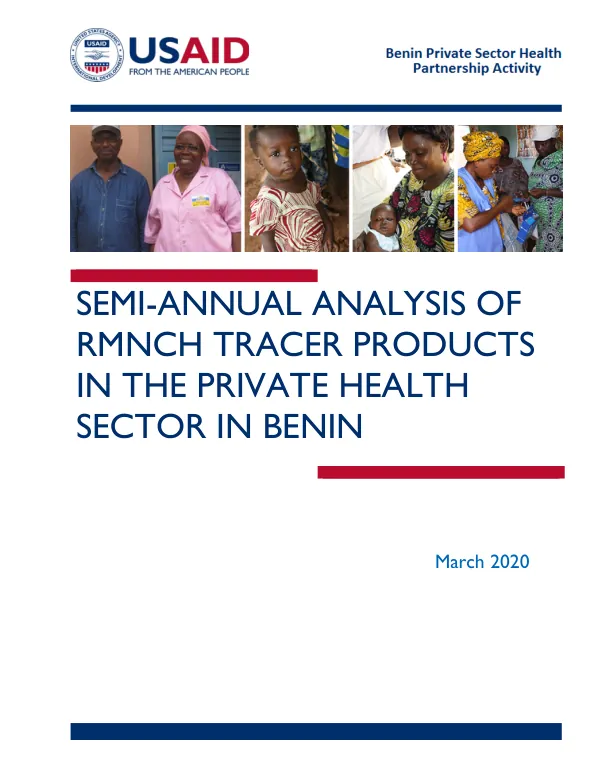
Semi-Annual Analysis of RMNCH Tracer Products in the Private Health Sector in Benin
The USAID Benin Private Sector Health Partnership Activity (PSHPA) is a five-year project in Benin that aims to increase the use of high-impact reproductive, maternal, newborn, and child health (RMNCH) services and products delivered by the private sector nationwide.
2020 · 25 pages
Sign in to readA free account is required to download.
Abstract
The project is linked to the sub-intermediate result (IR) I.I of the USAID/Benin Results Framework, "Improved access to high-impact health services," and has four IRs: IR 1, IR 2, IR 3, and IR 4. The project focuses on increasing the availability of affordable and quality health products through private sector channels, strengthening public-private engagement to promote universal RMNCH outcomes, and identifying, piloting, and applying innovative private sector models. The project is implemented by Abt Associates Inc. in collaboration with MCDI, EnCompass, IQVIA, PSSP, ANPME, CEBAC-STP, and USAID Benin Private Sector Health Partnership Activity. The project's methodology involves analyzing the availability and distribution of RMNCH products in the private sector, including family planning, antimalarials, vaccines, water purification products, and rehydration salts. The analysis is conducted by department and by product category, and the results are presented in tables and figures. The analysis of family planning products shows that the volume and value of these products increased from the first half (H1) to the second half (H2) of the project period. The distribution of contraceptive pills and injectables by department indicates that these products are widely available in the private sector. The analysis of antimalarials shows that the volume and value of these products also increased from H1 to H2, with a significant increase in the distribution of artemisinin-based combination therapies. The analysis of vaccines shows that the volume and value of these products increased from H1 to H2, with a significant increase in the distribution of pentavalent vaccines. The analysis of water purification products shows that the volume and value of these products increased from H1 to H2, with a significant increase in the distribution of chlorine tablets. The analysis of rehydration salts shows that the volume and value of these products increased from H1 to H2, with a significant increase in the distribution of oral rehydration salts. The analysis of ORS/Zinc shows that the volume and value of these products increased from H1 to H2, with a significant increase in the distribution of zinc supplements. The project's conclusion is that the private sector in Benin has made significant progress in increasing the availability and distribution of RMNCH products, particularly in the areas of family planning, antimalarials, vaccines, water purification products, and rehydration salts. The project recommends that the private sector continue to play a key role in increasing access to RMNCH services and products in Benin. The project's results are presented in tables and figures, which show the analysis parameters used by type of RMNCH product, the distribution of RMNCH products by department, and the comparison of volumes and values of RMNCH products at the wholesale level. The project's methodology and results are presented in a clear and concise manner, making it easy to understand the project's findings and recommendations.