ABT ASSOCIATES
The Private Sector’s Role in Providing HIV Services in Ivory Coast
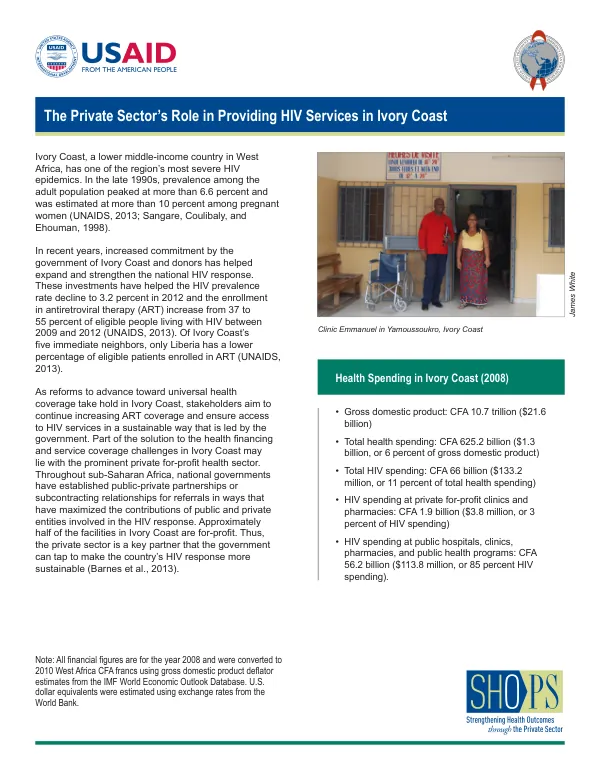
Ivory Coast, a lower middle-income country in West Africa, has one of the region's most severe HIV epidemics.
2014 · 4 pages
Sign in to readA free account is required to download.
Abstract
In the late 1990s, prevalence among the adult population peaked at more than 6.6 percent and was estimated at more than 10 percent among pregnant women. The government of Ivory Coast and donors have increased their commitment to the national HIV response, resulting in a decline in HIV prevalence to 3.2 percent in 2012. The enrollment in antiretroviral therapy (ART) has increased from 37 to 55 percent of eligible people living with HIV between 2009 and 2012. Ivory Coast's five immediate neighbors have lower ART coverage, with Liberia having the lowest percentage of eligible patients enrolled in ART. As the government of Ivory Coast advances toward universal health coverage, stakeholders aim to continue increasing ART coverage and ensure access to HIV services in a sustainable way. The private sector is a key partner in making the country's HIV response more sustainable. Approximately half of the facilities in Ivory Coast are for-profit, and the private sector is a significant contributor to the country's health spending. In 2008, the private sector accounted for 3 percent of HIV spending, with the majority of spending coming from public hospitals, clinics, pharmacies, and public health programs. The flow of HIV funds in Ivory Coast is largely dependent on donors, who account for 87 percent of HIV spending. The government of Ivory Coast provides 7 percent of HIV funds, with the remaining 6 percent coming from households of people living with HIV and private businesses. Donor and government spending has kept out-of-pocket expenditures on HIV at 3 percent, which is 63 percentage points lower than out-of-pocket spending on general health. Despite the availability of subsidized services in public sector facilities, ART coverage remains low, with only 55 percent of eligible people living with HIV enrolled in ART in 2012. Out-of-pocket payments for general health are significant, but out-of-pocket payments by people living with HIV account for only 3 percent of HIV expenditures. This indicates that donor funding and a government policy abolishing fees for HIV goods and services reduce the financial burden on those seeking care. The government of Ivory Coast will need to consider how to fill the gap in financial coverage for people living with HIV, particularly in the private sector. The country's HIV response is highly dependent on donors, which accounted for 87 percent of HIV spending in 2008. As the government pursues universal health coverage goals, it will need to consider how to reduce its dependency on donors and increase its own contribution to HIV funding. The Strengthening Health Outcomes through the Private Sector (SHOPS) project has been working to increase the availability, improve the quality, and expand the coverage of essential health products and services in family planning and reproductive health, maternal and child health, HIV and AIDS, and other health areas through the private sector. The project has been funded by the U.S. Agency for International Development (USAID) and is led by Abt Associates, in collaboration with several other organizations. The SHOPS project has provided valuable insights into the flow of HIV funds in Ivory Coast and the role of the private sector in the country's HIV response. The project's findings have important implications for policy and program development in Ivory Coast and other countries in the region.