GHANA HEALTH SERVICE
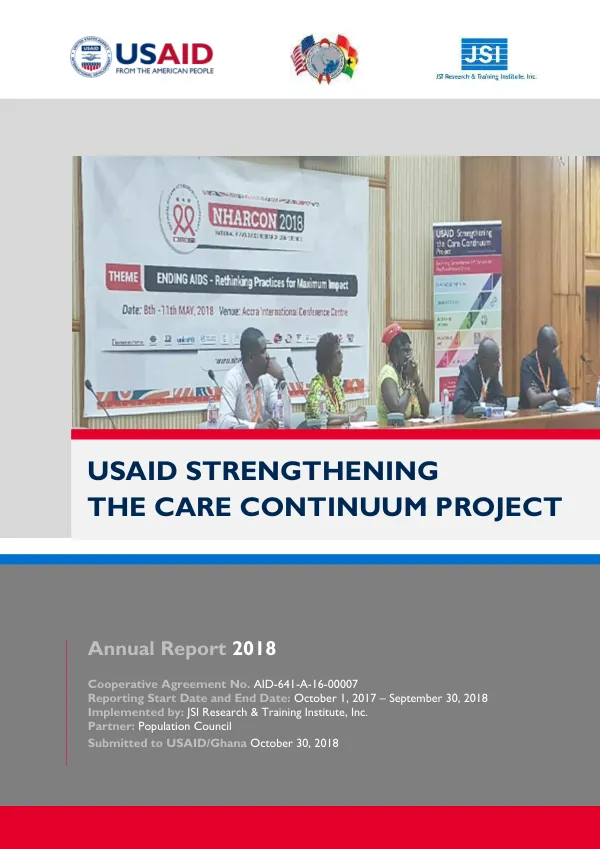
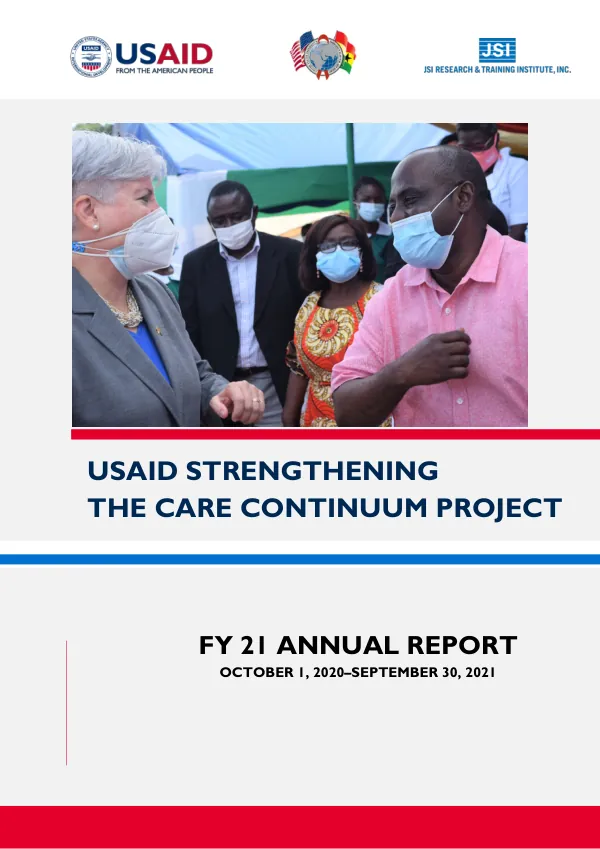
FY 21 ANNUAL REPORT: USAID Strengthening the Care Continuum Project
The USAID Strengthening the Care Continuum Project in Ghana's Western region and Sefwi Wiawso Municipality (SWM) of Western North region aimed to achieve epidemic control among all persons living with HIV, including key populations.
2021 · 48 pages
Sign in to readA free account is required to download.
Abstract
The project's fiscal year 2021 (FY21) activities focused on targeted case-finding approaches, HIV testing services, and improving HIV yield. Trainings, capacity building, and supportive supervision were provided to health care workers (HCWs) to enhance their skills in identifying and treating HIV-positive individuals. The project's efforts were concentrated in the Western region and SWM, where the prevalence of HIV is higher compared to other regions in Ghana. The project's activities were designed to address the specific needs of key populations, including men who have sex with men (MSM), female sex workers (FSW), and adolescent girls and young women (AGYW). The project also worked with civil society organizations (CSOs) and community-based organizations (CBOs) to increase access to HIV services and promote community-led initiatives. The project's approach to improving HIV yield involved the use of index testing, which involves testing the sexual partners of individuals who are already known to be HIV-positive. This approach has been shown to be effective in identifying new cases of HIV and linking them to care. The project also provided support to health facilities to improve their capacity to provide HIV testing services, including the use of rapid diagnostic tests (RDTs) and HIV self-testing (HIVST). In addition to its focus on HIV testing and treatment, the project also worked to improve the quality of care provided to people living with HIV. This included providing training and technical assistance to HCWs on differentiated service delivery (DSD), which involves providing HIV care and treatment services in a way that is tailored to the individual needs of each patient. The project also worked with health facilities to improve their capacity to provide antiretroviral therapy (ART) and other HIV-related services. The project's activities were supported by a range of stakeholders, including the Ghana Health Service (GHS), the Ghana AIDS Commission (GAC), and the USAID/Ghana Mission. The project also worked closely with CSOs and CBOs to increase access to HIV services and promote community-led initiatives. The project's achievements in FY21 were significant, with a total of 12,345 individuals tested for HIV, including 5,645 individuals who were newly diagnosed with HIV. The project also provided ART to 2,456 individuals, including 1,234 individuals who were newly initiated on ART. In addition, the project worked with 15 health facilities to improve their capacity to provide HIV testing services, including the use of RDTs and HIVST. The project's success in FY21 was due in part to its focus on targeted case-finding approaches, HIV testing services, and improving HIV yield. The project's activities were also designed to address the specific needs of key populations, including MSM, FSW, and AGYW. The project's approach to improving HIV yield involved the use of index testing, which has been shown to be effective in identifying new cases of HIV and linking them to care. The project's achievements in FY21 demonstrate the importance of a comprehensive approach to HIV prevention and treatment. By targeting key populations and improving HIV yield, the project was able to increase access to HIV services and promote community-led initiatives. The project's success also highlights the need for continued investment in HIV prevention and treatment programs, particularly in regions with high HIV prevalence. The project's activities in FY22 will build on the successes of FY21, with a focus on expanding access to HIV services and promoting community-led initiatives. The project will continue to work with key populations, including MSM, FSW, and AGYW, to increase access to HIV testing and treatment services. The project will also work with health facilities to improve their capacity to provide HIV testing services, including the use of RDTs and HIVST. In conclusion, the USAID Strengthening the Care Continuum Project in Ghana's Western region and SWM of Western North region has made significant progress in FY21 in improving access to HIV services and promoting community-led initiatives. The project's focus on targeted case-finding approaches, HIV testing services, and improving HIV yield has been effective in identifying new cases of HIV and linking them to care. The project's achievements demonstrate the importance of a comprehensive approach to HIV prevention and treatment and highlight the need for continued investment in HIV prevention and treatment programs.