TETRA TECH
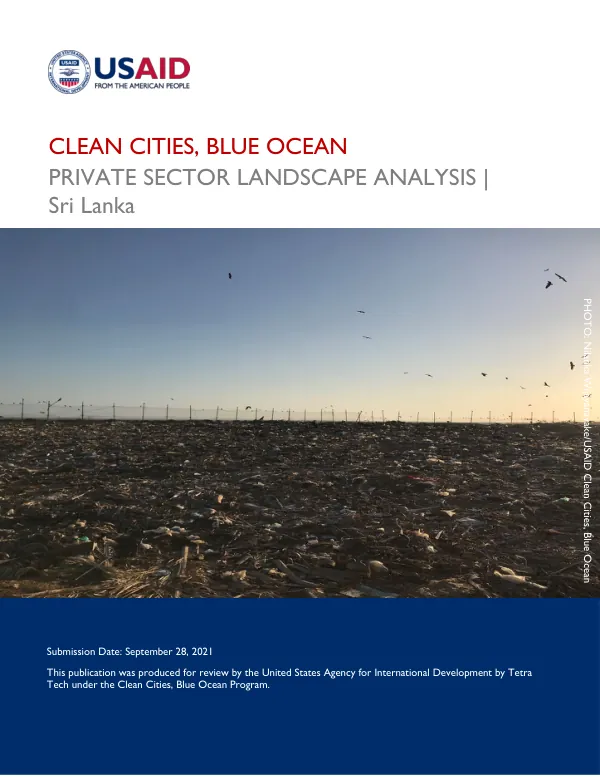
Private Sector Landscape Analysis | Sri Lanka
The Clean Cities, Blue Ocean (CCBO) Program is a five-year initiative funded by the U.S.
2021 · 37 pages
Sign in to readA free account is required to download.
Abstract
Agency for International Development (USAID) to address the global crisis of marine plastic pollution. The program's objectives include promoting the reduce, reuse, recycle (3Rs) approach, strengthening local and regional markets for recycled plastics, building social and behavior change for 3Rs and sustainable solid waste management, increasing capacity and effective governance of solid waste management and recycling systems, and supporting international fora, public-private partnerships, and multi-stakeholder alliances. CCBO is working in seven focal countries in Asia and Latin America and the Caribbean, with a focus on Sri Lanka, Indonesia, the Maldives, the Philippines, Vietnam, the Dominican Republic, and Peru. In Sri Lanka, CCBO is piloting solutions to stop the flow of plastic pollution to the waters within and surrounding the country through work in the Colombo Metropolitan Area, Galle, and Jaffna, as well as through support to national-level initiatives. The program seeks to identify stakeholders who share the same interest and wish to collaborate, avoiding duplication of efforts and sharing knowledge to achieve innovative solutions. CCBO strongly believes that local solutions are key to addressing the global challenge of ocean plastics pollution. In collaboration with global, regional, national, and local stakeholders, CCBO is implementing a range of activities to achieve its objectives. A key aspect of CCBO's work in Sri Lanka is the identification of private sector entities that may be able to advance, amplify, and/or increase the sustainability of CCBO's activities. This includes companies, trade associations, and other organizations that have an interest in reducing plastic pollution and promoting sustainable solid waste management practices. CCBO is working with these stakeholders to develop innovative solutions to address the challenges of marine plastic pollution in Sri Lanka. The private sector landscape in Sri Lanka is characterized by a range of companies and organizations that have an interest in reducing plastic pollution and promoting sustainable solid waste management practices. These include brands and consumer goods companies, chemical, material, product, and packaging manufacturers, waste haulers, material recyclers, and waste management companies, trade associations, consultants, and service providers, and incubators, investors, and development organizations. CCBO has identified a number of opportunities for collaboration with the private sector in Sri Lanka, including the development of new products and services that promote sustainable solid waste management practices, the implementation of waste reduction and recycling programs, and the provision of training and capacity-building programs for private sector companies and their employees. By working with the private sector, CCBO aims to leverage the resources and expertise of these companies to achieve its objectives and make a meaningful impact in reducing plastic pollution in Sri Lanka. The CCBO program is working to overcome a number of challenges in Sri Lanka, including access to collection, waste separation, sorting, and cleaning, and increasing waste infrastructure and management capacity. CCBO has identified a number of organizations that have an interest in overcoming these challenges, including companies, trade associations, and other organizations that have an interest in reducing plastic pollution and promoting sustainable solid waste management practices. In conclusion, the CCBO program is a five-year initiative funded by the U.S. Agency for International Development (USAID) to address the global crisis of marine plastic pollution. The program is working in seven focal countries in Asia and Latin America and the Caribbean, with a focus on Sri Lanka, Indonesia, the Maldives, the Philippines, Vietnam, the Dominican Republic, and Peru. CCBO is working with private sector entities in Sri Lanka to develop innovative solutions to address the challenges of marine plastic pollution and promote sustainable solid waste management practices.