RWANDAN EDUCATION BOARD
Problem-Solving to Take Flight: Rwanda's First Math Camp
Mathematics education in Rwanda is undergoing a transformation with the introduction of problem-solving skills in primary schools.
2 pages
Sign in to readA free account is required to download.
Abstract
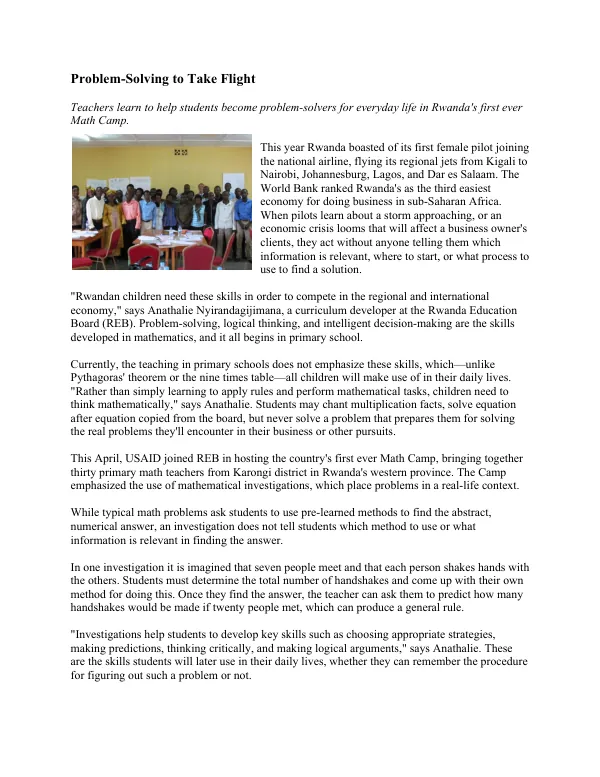
The Rwanda Education Board (REB) has partnered with USAID to host the country's first-ever Math Camp, which aims to equip primary math teachers with the skills to teach problem-solving, logical thinking, and intelligent decision-making. These skills are essential for children to compete in the regional and international economy. The current teaching methods in primary schools focus on applying rules and performing mathematical tasks, but do not emphasize problem-solving skills. Students are often asked to solve equations copied from the board, but are not given the opportunity to solve real-world problems that they will encounter in their daily lives. In contrast, mathematical investigations place problems in a real-life context, requiring students to think mathematically and come up with their own methods to find solutions. At the Math Camp, thirty primary math teachers from Karongi district in Rwanda's western province participated in a series of investigations that simulated real-world problems. For example, students were asked to determine the total number of handshakes that would occur if seven people met, and then to predict how many handshakes would be made if twenty people met. This type of investigation helps students develop key skills such as choosing appropriate strategies, making predictions, thinking critically, and making logical arguments. The Math Camp emphasized the importance of investigations in teaching problem-solving skills. Anathalie Nyirandagijimana, a curriculum developer at REB, stated that investigations help students to develop key skills that they will later use in their daily lives, whether they can remember the procedure for figuring out such a problem or not. The teachers who participated in the Math Camp made action-plans for implementing aspects of the Camp into their teaching, with one teacher, Leonard Ndamyabera, stating that he will begin using investigations to help his students better understand mathematics. The introduction of problem-solving skills in primary schools is expected to have a positive impact on Rwanda's economy. With a growing number of businesses and entrepreneurs, the country needs a workforce that is equipped with the skills to solve real-world problems. By teaching problem-solving skills from a young age, Rwanda is investing in the future of its economy and its people.
Related documents