USAID
Procedures for Protection of Human Subjects in Research Supported by USAID
The Common Federal Policy for Protection of Human Subjects, adopted by USAID, sets standards for safeguarding the rights and welfare of human research subjects involved in research supported by the agency.
7 pages
Sign in to readA free account is required to download.
Abstract
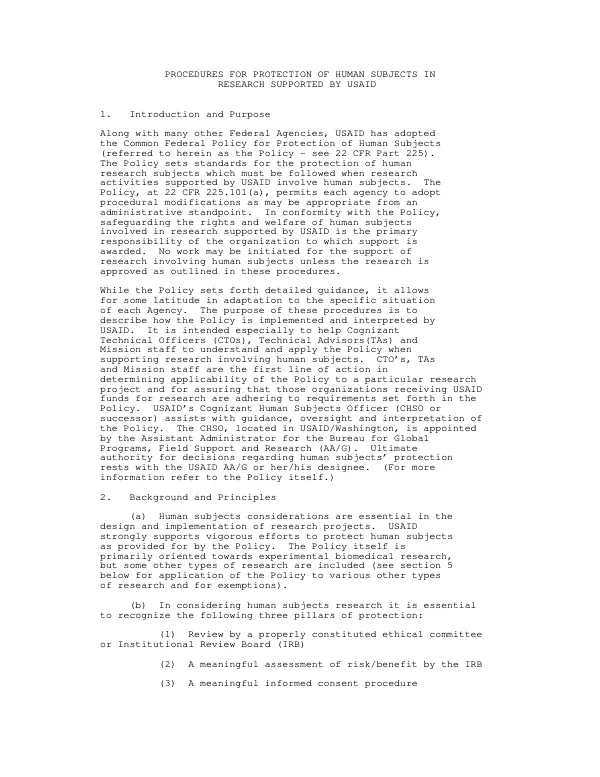
The Policy, outlined in 22 CFR Part 225, requires each agency to adopt procedural modifications as necessary from an administrative standpoint. USAID's primary responsibility is to ensure the protection of human subjects involved in research supported by the agency. The Policy emphasizes the importance of protecting human subjects, particularly in experimental biomedical research, and recognizes that foreign countries may present special situations. USAID will accept legitimate foreign procedural systems, such as those complying with the World Medical Assembly Declaration, as long as they provide protection at least equivalent to the Policy. The Policy also acknowledges that research in foreign countries must conform to local laws and regulations regarding the protection of human research subjects. USAID's implementation of the Policy seeks to balance the need to protect human subjects with the need to avoid undue burden. The agency emphasizes practicality, flexibility, and common sense in its application of the Policy. In cases where research takes place in the U.S., the Policy must be fully implemented, and recipient institutions must comply with all aspects of the Policy. When research is conducted in foreign countries, USAID may accept alternative protection procedures if they can be determined to be at least equivalent to the Policy. The Policy applies to research involving living human subjects, including samples derived from living subjects. It defines research as a systematic investigation designed to develop or contribute to generalizable knowledge. The Policy applies to various types of activities, including experimental biomedical research, survey research, and demographic data collection. In cases where research involves human subjects, the Policy requires review by a properly constituted ethical committee or Institutional Review Board (IRB), a meaningful assessment of risk/benefit, and a meaningful informed consent procedure. USAID's Cognizant Human Subjects Officer (CHSO) assists with guidance, oversight, and interpretation of the Policy. The CHSO is responsible for determining whether alternative protection procedures are at least equivalent to the Policy and for publishing such determinations in the Federal Register. The Policy also requires a justification memorandum for individual or class of research activities, which must describe how the alternative system provides the three pillars of protection. In summary, the Common Federal Policy for Protection of Human Subjects, adopted by USAID, sets standards for safeguarding the rights and welfare of human research subjects involved in research supported by the agency. The Policy emphasizes the importance of protecting human subjects, particularly in experimental biomedical research, and recognizes that foreign countries may present special situations. USAID's implementation of the Policy seeks to balance the need to protect human subjects with the need to avoid undue burden.