USAID
Profiles of Farming Practices in the Sahel
Farmers in the Sahel region employ a variety of crop management practices to adapt to seasonal variations in temperature and rainfall.
2014 · 2 pages
Sign in to readA free account is required to download.
Abstract
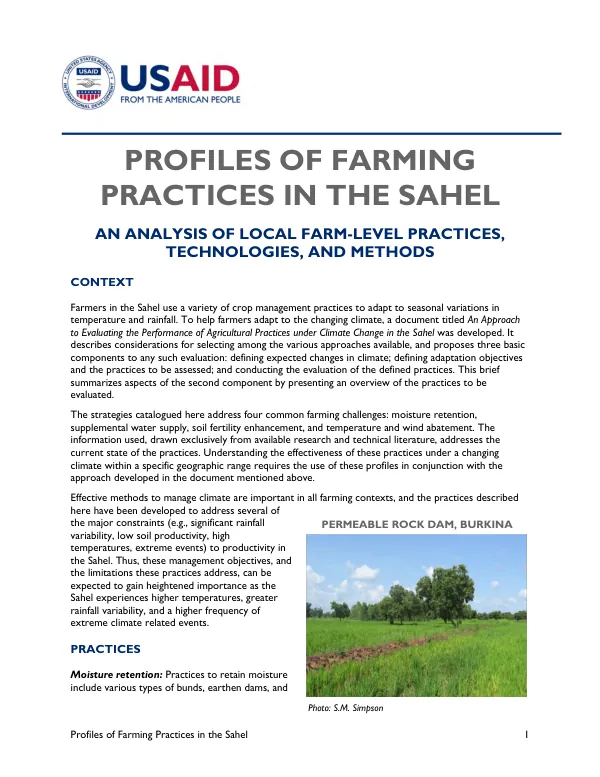
These practices address four common farming challenges: moisture retention, supplemental water supply, soil fertility enhancement, and temperature and wind abatement. Moisture retention practices include various types of bunds, earthen dams, and weirs suitable for a range of topographies and rainfall. Some bund types require less maintenance and are suitable for mixed cropland and grazing situations. Weirs and permeable rock dams are particularly useful where high rainfall and flooding are common, and the dams can also help prevent erosion. Microcatchments are useful in areas with low rainfall, and contour ridges can be used in many situations to help retain water. For large-scale water harvesting, a technique that uses a specialized plow to create a water-retaining furrow can be used. Land rehabilitation can be accomplished using planting pits, or zai. Supplemental water supply is provided through irrigation and dams. Drip irrigation and pump irrigation are commonly used in West Africa. Small earthen dams and check dams can be used to trap water for agricultural use where runoff water is available from upstream catchments. Lowlands and river floodplains can be developed to take advantage of seasonal water availability. Soil fertility enhancement can be achieved through various methods. In areas where rice cultivation already occurs, fertility of the soil can be improved through intensification, which is labor-intensive but conserves water. Agroforestry, the practice of mixing cropland with trees, improves fertility in a wide range of situations. Conservation agriculture, which involves the integrated management of soil, water, and biological material, is also suited to many agricultural situations in West Africa. Traditional organic fertilizer sources, such as manure, compost, and mulch, can be used to add nutrients to many types of soils. Micro-dosing has proven effective and economical in areas where chemical fertilizers are desirable but the cost is high. Integrated soil fertility management combines both organic and chemical fertilizers to maximize the benefit to soils. Temperature and wind abatement can be achieved through various strategies. Stabilization of sand dunes, a major strategy for preventing encroachment on farmlands, is typically done either by erecting physical barriers, such as fences, or planted barriers. Firebreaks are commonly used to protect farmlands and structures from bushfires during the dry season. These management objectives and the limitations these practices address are expected to gain heightened importance as the Sahel experiences higher temperatures, greater rainfall variability, and a higher frequency of extreme climate-related events.