USAID
Groundwater Management: Addressing the Threats of Climate Change in West Africa
Groundwater management in West Africa is critical due to the region's reliance on groundwater resources for safe drinking water and economic activities.
2014 · 2 pages
Sign in to readA free account is required to download.
Abstract
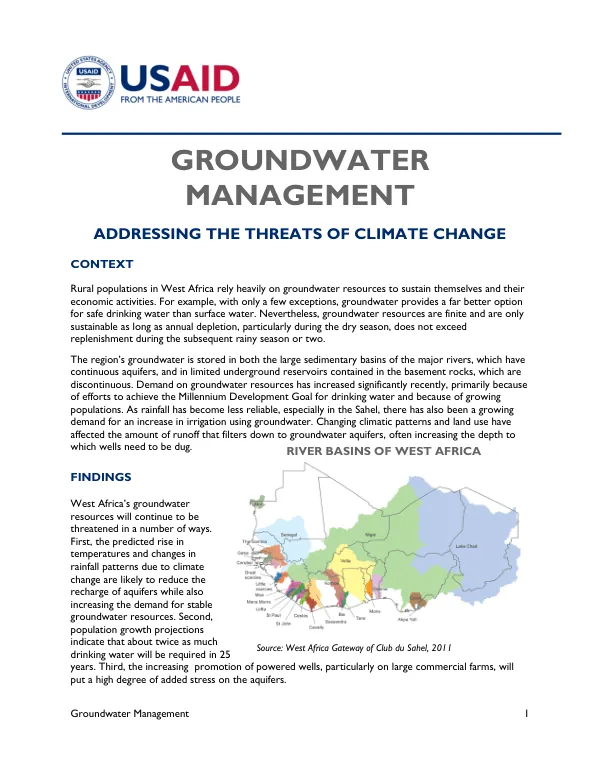
Groundwater is stored in both large sedimentary basins of major rivers and limited underground reservoirs contained in basement rocks. Demand on groundwater resources has increased significantly, primarily due to efforts to achieve the Millennium Development Goal for drinking water and growing populations. As rainfall has become less reliable, especially in the Sahel, there has also been a growing demand for an increase in irrigation using groundwater. The predicted rise in temperatures and changes in rainfall patterns due to climate change are likely to reduce the recharge of aquifers while also increasing the demand for stable groundwater resources. Population growth projections indicate that about twice as much drinking water will be required in 25 years. The increasing promotion of powered wells, particularly on large commercial farms, will put a high degree of added stress on the aquifers. West Africa's groundwater resources will continue to be threatened in a number of ways. Current water management initiatives in West Africa mainly consist of a national dialogue and do not reach down to the local level, where water is used and managed. Groundwater monitoring, where it is done, is underfunded and does not always monitor the most critical locations. What databases on groundwater do exist are generally kept by national institutions and typically are not available to those at the local level who manage water resources. Institutional and scientific capacity to manage groundwater effectively is generally weak. The sustainable management of groundwater will likely require an Integrated Water Resources Management approach (IWRM). IWRM involves managing surface water and groundwater together in a manner that seeks to address both the demand for and the supply of water. IWRM is a participatory process that requires the involvement of all stakeholders, from national government departments and agencies down to individual users. In IWRM, users help to define management targets and help to regulate and police water use. It addresses demand through education, changes in cropping patterns, water pricing, and regulation and addresses supply through improved resource management, soil conservation, and augmenting groundwater recharge. Effective management systems help create a stable production system with the capacity to respond to threats and changing conditions, including those posed by climate change. When planning effective utilization of groundwater resources, it is essential to understand the overall hydrogeologic setting of any particular area within the West African context. The Multiple-Use Services model, piloted in Niger, could be implemented in rural West Africa to implement IWRM. IWRM can also be added as a component to agriculture and food security programs to properly integrate water, agriculture, and human development. Central government support for IWRM should focus on policy, research, and the regulatory framework.