USAID
Profiles of Success: Vietnamese Women in the Construction Industry
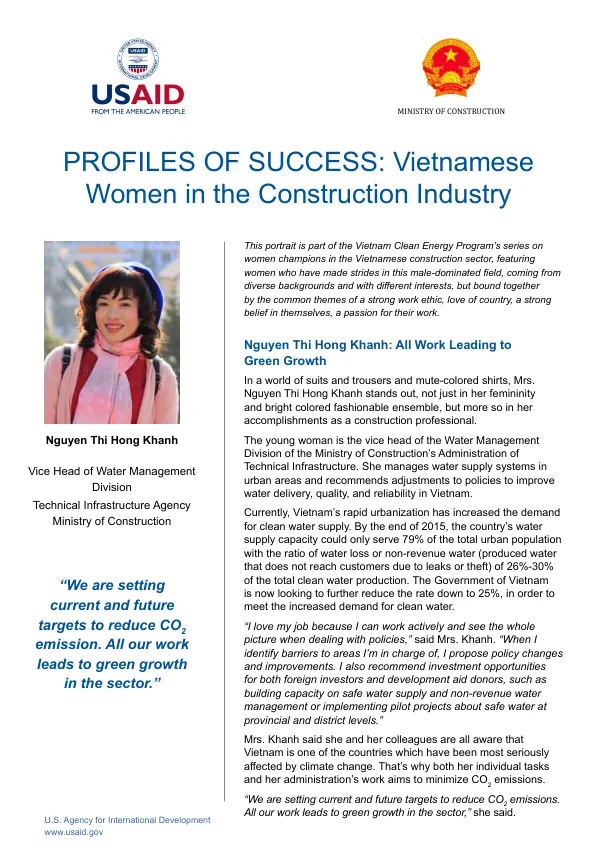
Nguyen Thi Hong Khanh is the vice head of the Water Management Division of the Ministry of Construction's Administration of Technical Infrastructure.
2017 · 2 pages
Sign in to readA free account is required to download.
Abstract
She manages water supply systems in urban areas and recommends adjustments to policies to improve water delivery, quality, and reliability in Vietnam. The country's rapid urbanization has increased the demand for clean water supply, with the current water supply capacity serving only 79% of the total urban population by the end of 2015. The ratio of water loss or non-revenue water is 26%-30% of the total clean water production, with the government aiming to reduce this rate to 25%. Mrs. Khanh's work focuses on minimizing CO2 emissions, with her administration setting current and future targets to reduce CO2 emissions. She believes that all work leads to green growth in the sector, and her individual tasks and her administration's work aim to achieve this goal. In 2016, Mrs. Khanh worked with the USAID Vietnam Clean Energy Program to develop the construction sector's Green Growth Action Plan (GGAP) with an emphasis on urban infrastructure. She proposed 20 priorities to promote green growth in the urban infrastructure sector, including improving regulations and technologies, building capacity, and promoting awareness of issues affecting water supply and security. The USAID-funded Vietnam Clean Energy Program provides technical assistance for the ministry's GGAP formulation, which will be submitted to the government for approval in 2017. Mrs. Khanh hopes that the program will be able to publicly share its findings and recommendations for all technical divisions under the ministry. Despite facing challenges such as poor cooperation among agencies at different levels, low quality of services, and incomplete strategies, Mrs. Khanh believes that the management of water supply, drainage, solid waste, and traffic is becoming a major interest in Vietnam. Mrs. Khanh's leadership style is characterized by her flexibility and affability when working with her teammates. She is devoted to her work and willing to help others, which she believes are advantages over other male leaders. As a young role model, Mrs. Khanh is considered to develop and flourish to become a leader in the sector and inspire other women to make a difference in their country. Her work and leadership style serve as an example of the importance of promoting green growth and sustainable development in the construction sector.