USAID
Profiles of Success: Vietnamese Women in the Construction Industry
Vietnamese women are making strides in the construction industry, driven by a strong work ethic, love of country, and a passion for their work.
2017 · 2 pages
Sign in to readA free account is required to download.
Abstract
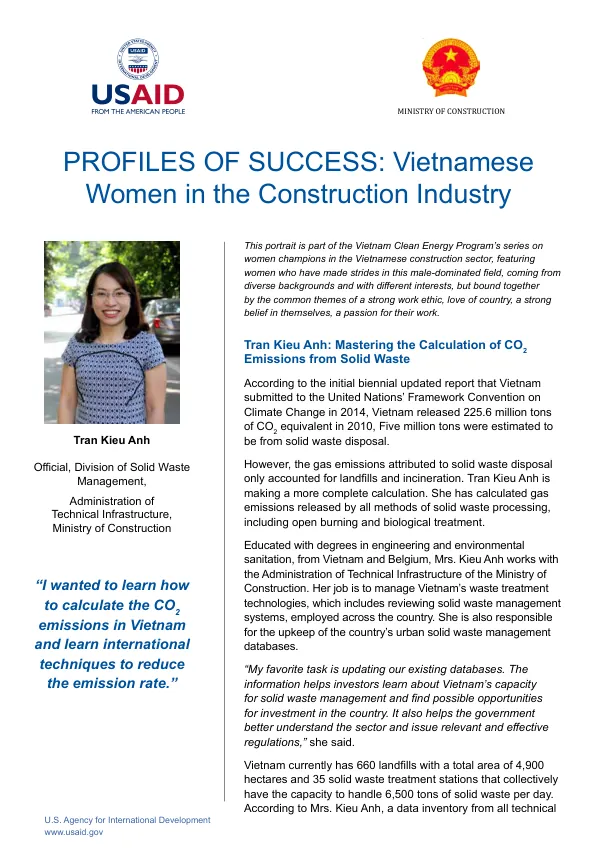
Tran Kieu Anh, a master of calculating CO2 emissions from solid waste, is one such example. As the official in charge of solid waste management at the Ministry of Construction, Anh has calculated emissions released by all methods of solid waste processing, including open burning and biological treatment. Anh's work is crucial in Vietnam's efforts to reduce greenhouse gas emissions. The country released 225.6 million tons of CO2 equivalent in 2010, with five million tons attributed to solid waste disposal. Anh's calculations, however, take into account emissions from all solid waste management methods. Her findings indicate that buried solid waste releases the most CO2, followed by burnt waste and biotechnologically-treated waste. Anh's expertise has been instrumental in updating Vietnam's urban solid waste management databases. This information helps investors understand the country's capacity for solid waste management and identify opportunities for investment. It also enables the government to issue relevant regulations and policies to promote green growth. Anh's work has been recognized by the Vietnam Clean Energy Program, which has provided her with emission calculation tools and supported her research. Vietnam's solid waste management infrastructure is still in its early stages, with 660 landfills and 35 solid waste treatment stations. Anh's research has highlighted the need for effective models for solid waste sorting and recycling, as well as increased financing for solid waste management. She believes that other countries can sort waste at source to reduce CO2 emissions, and she is working to implement similar solutions in Vietnam. Anh's dedication to her work is evident in her long hours and frequent site visits to learn about waste management conditions. She credits her family's support for allowing her to balance her work and personal life. Anh's five-year-old daughter brings her joy and motivation to continue her work in reducing CO2 emissions and promoting green growth in Vietnam. The Vietnam Clean Energy Program is working to calculate CO2 emissions from water supply systems, solid waste, and wastewater treatment. Anh's research has been instrumental in this effort, and her proposals for reducing CO2 emissions in the construction sector by 2020 have been well-received. Her work serves as a model for other women in the construction industry, demonstrating the importance of their contributions to Vietnam's green growth strategy.