AFGHANISTAN MINISTRY OF AGRICULTURE, IRRIGATION AND LIVESTOCK
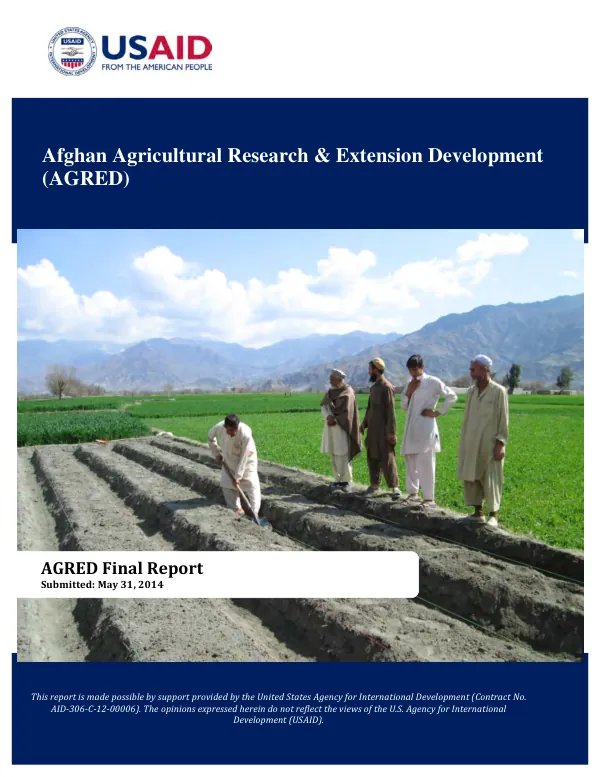
AGRED Final Report
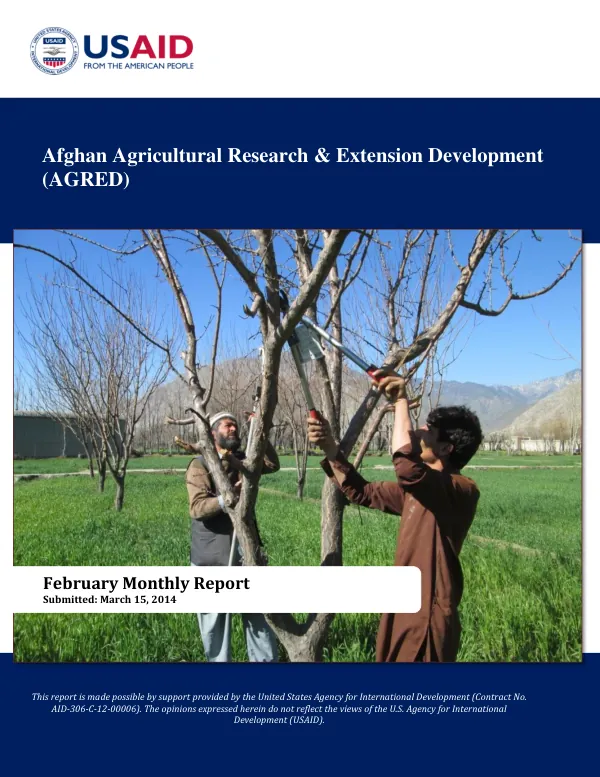
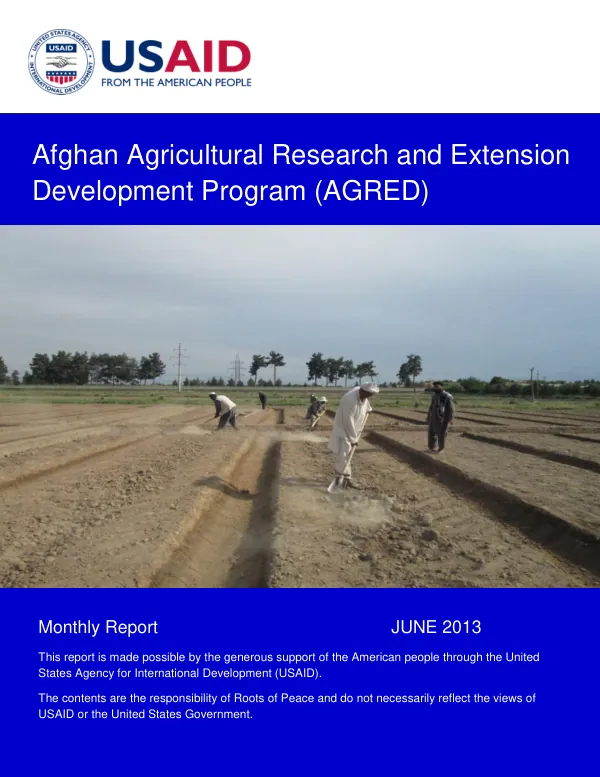
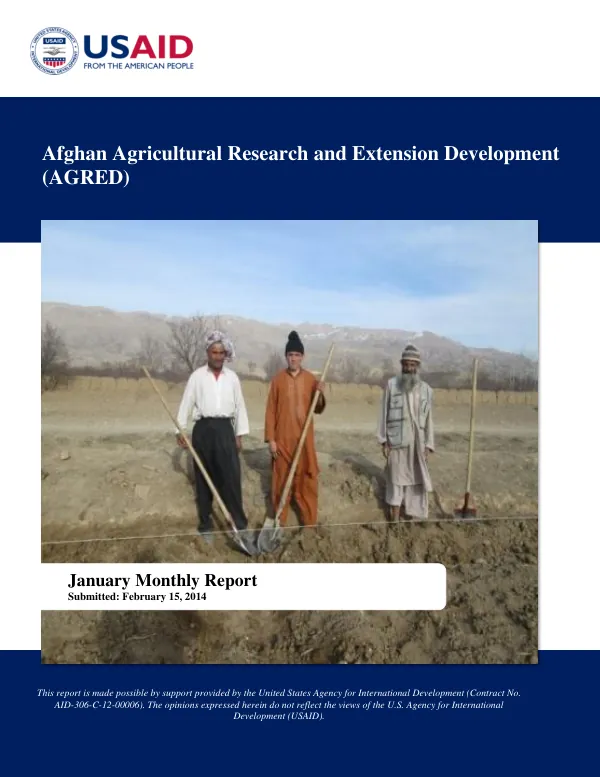
The Afghan Agricultural Research & Extension Development (AGRED) program aimed to increase agricultural productivity and income through the application of science and technology.
2014 · 35 pages
Sign in to readA free account is required to download.
Abstract
The program built the capacity of the Government of the Islamic Republic of Afghanistan's (GIRoA) Ministry of Agriculture, Irrigation and Livestock (MAIL) and Directorates of Agriculture, Irrigation and Livestock (DAIL) to sustainably procure and deploy productivity-enhancing technologies and best practices. AGRED was designed to provide technical support to the Government of Afghanistan as it implemented a companion agreement, funded through an Implementation Letter negotiated between the Government of Afghanistan and USAID and implemented by MAIL. The Implementation Letter outlined formal requirements to receive planned on-budget assistance to support research and extension activities. Roots of Peace, as USAID AGRED contractor, was responsible for preparing MAIL to receive funds "on-budget," and throughout the Implementation Letter process. The program sought to facilitate farmers' access to productivity-enhancing technologies and knowledge, institutionalize an integrated research and extension system, and rebuild critical assets of selected research and extension centers and stations. AGRED aimed to achieve its objective by accomplishing four Expected Results: more effective communication with and increased access to improved technologies, knowledge, and education with emphasis on agriculture best practices by Afghan farmers; improved applied research and extension infrastructure in seven target sub-national research stations and fifty target districts; training and capacity building of research and extension staff to deliver services to Afghan farm communities; and applied research and extension grants to support and sustain Afghanistan's capacity to improve production in its agricultural economy. The capacity development work focused on MAIL and 26 DAILs as well as the Research Stations in the seven provinces of Balkh, Herat, Kabul, Kandahar, Kunduz, Nangarhar, and Paktya. The facilitation of access to technologies and knowledge was designed to be implemented in 50 MAIL priority districts in the seven target provinces, as well as in Badghis, Baghlan, Balkh, Faryab, Ghazni, Hirat, Jowzjan, Kabul, Kunduz, Parwan, Samangan, Takhar, and Zabul. In December 2013, USAID and MAIL eliminated the on-budget component, and AGRED was reoriented to be implemented through off-budget support. The program continued to focus on its four Expected Results, with a revised work plan and implementation mechanisms in place. The AGRED partnership involved several key stakeholders, including the Afghan Agricultural Extension Project (AAEP), the Capacity Building Change Management Program (CBCMP), the International Maize and Wheat Improvement Center (CIMMYT), eAfghan Ag (e-AA), and the Japan International Cooperation Agency (JICA). The program's implementation mechanisms included on-budget and off-budget support, mini project overview, and moving beyond the mini project model. The AGRED partnership also focused on expected results, including more effective communication with Afghan farmers, improved applied research and extension infrastructure, training and capacity building of MAIL/DAIL staff, and applied research and extension grants. The program's financial report and annexes provide additional information on the program's implementation and outcomes. The program's "Lessons Learned" and recommendations section highlights key takeaways from the program's implementation, including the importance of a phased approach, staffing for management, and managing expectations. The section also emphasizes the need for GIRoA to take ownership of the program's outcomes and for USAID to provide sustained support to the program.