CONSULTORÍA PARA LOS DERECHOS HUMANOS Y EL DESPLAZAMIENTO – CODHES
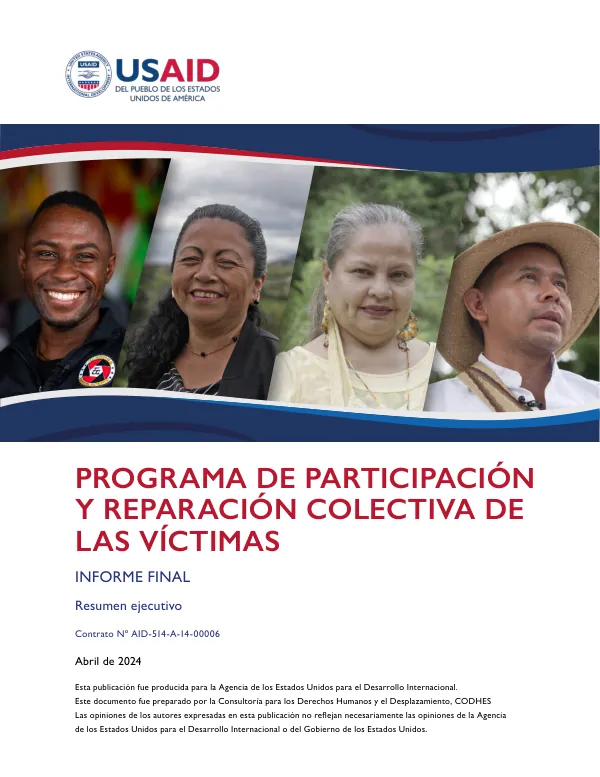
Programa de Participación y Reparación Colectiva de las Víctimas (Fase II)
The Programa de Participación y Reparación Colectiva de las Víctimas (PPRCV) is a program implemented by Consultoría para los Derechos Humanos y el Desplazamiento (CODHES) with funding from the United States Agency for International Development (USAID).
2019 · 18 pages
Sign in to readA free account is required to download.
Abstract
The program aims to promote the participation of victims in the implementation of the Law of Victims and Restitution of Lands, and to influence the formulation of public policies that contribute to the guarantee of victims' rights in the framework of peace and reconciliation processes. The program has two phases: Fase I and Fase II. During Fase I, the program focused on promoting the participation of victims in the implementation of the Law of Victims and Restitution of Lands, and on influencing the formulation of public policies that contribute to the guarantee of victims' rights. The program had three components: Fortalecimiento de las capacidades organizacionales y operativas de las organizaciones de víctimas y de la sociedad civil, Apoyo a las iniciativas de las organizaciones de víctimas y de la sociedad civil, and Promover la participación efectiva en procesos de reparación colectiva. During Fase II, the program aims to advocate for a greater respect for victims' rights to truth, justice, integral reparation, and non-repetition, within the current legal framework and the development of normative and public policies for the implementation of the Peace Agreement between the Government of Colombia (GdC) and the FARC. The program has three specific objectives: Territorialization of the Law of Victims, Acuerdo de Paz, and related policies; Fortalecimiento organizacional; and Incidir en los procesos de producción legal y/o de jurisprudencia para implementar el Acuerdo de Paz. The program has a geographic focus on several regions in Colombia, including the Costa Caribe, Tolima, Meta, Buenaventura, and Pasto. The program has established a monitoring and evaluation system to track its progress and adjust its strategies as needed. The program has also established measures to minimize the risk of loss of information, such as the realization of backups in the regional offices and the sending of information to Bogotá for storage. The program's theory of change is based on the idea that by promoting the participation of victims in the implementation of the Law of Victims and Restitution of Lands, and by influencing the formulation of public policies that contribute to the guarantee of victims' rights, the program can contribute to the achievement of the objective of Incidir en los procesos de producción legal y/o de jurisprudencia para implementar el Acuerdo de Paz. The program has identified several intermediate results, including the knowledge, follow-up, and vigilance of victims in the focalized zones regarding the effects on their rights derived from the PDETs and collective reparation in the program zones, and the effective participation of victims in the design, implementation, and monitoring of the application of the gender and ethnic approach in the territorial implementation of the Peace Agreement. The program has also identified the components of the guarantees of non-repetition, with the aim of managing them in the competent institutional spaces, so that the facts that gave rise to victimization do not repeat themselves. The program has positioned proposals aimed at guaranteeing the rights of victims before the legislative, executive, and judicial branches of government.
Related documents