USAID DEC
Programa de Regularización de derechos de propiedad para generar valor económico
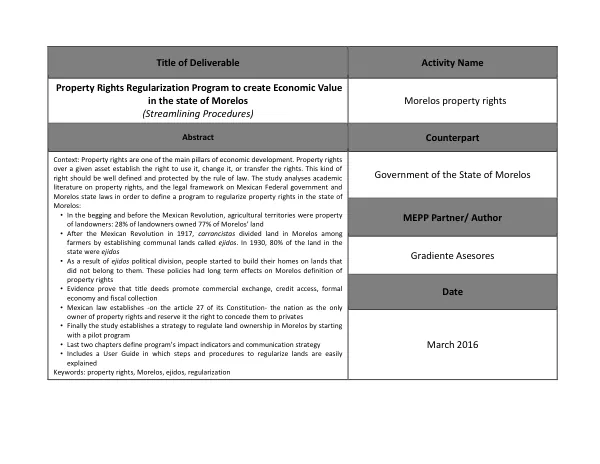
Property Rights Regularization Program to Create Economic Value in the State of Morelos The concept of property rights is a fundamental pillar of economic development, establishing the right to use, change, or transfer ownership of an asset.
2016 · 88 pages
Sign in to readA free account is required to download.
Abstract
In the state of Morelos, Mexico, property rights have been shaped by historical events, including the Mexican Revolution, which led to the establishment of communal lands called ejidos. By 1930, 80% of the land in Morelos was classified as ejidos, resulting in long-term effects on the definition of property rights. The study of property rights in Morelos reveals that title deeds promote commercial exchange, credit access, formal economy, and fiscal collection. However, the Mexican Constitution establishes the nation as the sole owner of property rights, reserving the right to grant them to private individuals. This has led to a complex situation, where many individuals lack formal documentation of their land ownership. The program aims to regulate land ownership in Morelos by starting with a pilot program. The strategy involves establishing a system that grants property rights to marginalized groups who currently lack legal documentation, thereby facilitating access to credit, promoting formalization, and increasing public revenue collection. The study draws on international experiences, including Peru, El Salvador, Cambodia, and Brazil, which have implemented property regularization programs. These experiences highlight the importance of considering factors such as equity, gender, and urban-ambiental implications when designing regularization programs. The Mexican experience is particularly relevant, as the country has a long history of property regularization efforts. The study identifies the origins and foundation of regularization programs, as well as examples of successful programs, including the experience of Peru, El Salvador, Cambodia, and Brazil. However, the study also notes that regularization programs can have unintended consequences, such as displacement of communities or loss of traditional land use rights. To mitigate these risks, the study provides recommendations for improving future interventions, including the establishment of a clear legal framework, evaluation mechanisms, and a focus on equity and gender. In terms of the legal framework applicable to land tenure in Morelos, the study highlights the importance of understanding the faculties, procedures, and ordinances related to expropriations. The study provides examples of expropriations, including the regularization and titling of human settlements and the construction of the Secretariat of Public Security in Morelos. The study also emphasizes the need to reorganize and strengthen the State Council for Territorial Ordering, elaborate a new Urban Code, and publish guidelines for regularization programs. By implementing these recommendations, the state of Morelos can create a more secure and equitable property rights system, promoting economic development and improving the lives of its citizens.
Related documents
Documents in this collection
 2012
2012USAID DEC
Propuesta Técnica y Financiera para el Uso de un Sistema Fotovoltaico Interconectado en el Municipio de Epazoyucan, Hidalgo
Open record 2016
2016USAID DEC