USAID DEC
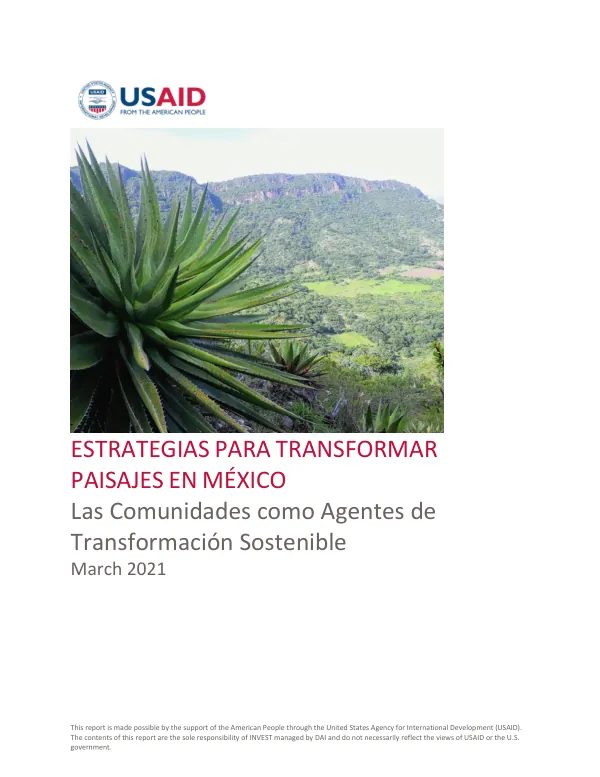
Estrategias para Transformar Paisajes en México: Las Comunidades como Agentes de Transformación Sostenible
Sign inDAI
Estrategias para Transformar Paisajes en México: Las Comunidades como Agentes de Transformación Sostenible
Initial assessments conducted in three regions - Campeche/Quintana Roo, Chiapas, and Oaxaca - identified deforestation, forest degradation, loss of biodiversity, and climate-related risks as primary challenges.
2021 · 36 pages
Sign in to readA free account is required to download.
Abstract
The conservation, restoration, and regeneration of forests are necessary to protect the livelihoods of communities and reduce risks for supply chains and investment attraction. Implementation focused on three key interventions: community-led landscape transformation, sustainable land-use planning, and market-based incentives. Community feedback indicated strong adoption of conservation practices, while market-based incentives faced implementation barriers due to high transaction costs. The report highlights the importance of addressing the root causes of deforestation and forest degradation in Mexico. The main causes of these issues are associated with structural problems, such as the conversion of land use to agricultural, tourist, and urban-industrial uses with higher profitability, often favored by deficiencies in control measures and ineffective or absent coordination between sectoral public policies that affect the same territory. The report emphasizes the need for a more sustainable approach to land use, prioritizing the conservation of natural, cultural, and spiritual capital associated with forests. It also highlights the importance of economic incentives that promote sustainable land use and forest conservation, such as the creation of market-based incentives and the provision of subsidies for sustainable forest management. The report concludes that there are many positive examples in Mexico, such as the Peninsular of Yucatan, Oaxaca, and Chiapas, which have been part of early actions of the mechanism INVEST. These examples demonstrate the potential for community-led landscape transformation, sustainable land-use planning, and market-based incentives to promote sustainable land use and forest conservation in Mexico. The report recommends the inclusion of a biodiversity conservation component, transparency, accountability, appropriation, leadership, governance, and budgeting, which are interrelated. It also emphasizes the need for local leadership, including the inclusion of women and young people, and the construction of governance structures at the landscape scale. Finally, it recommends that the private sector contribute more to the transformation processes at the landscape scale, ensuring the distribution of benefits at the landscape scale, and designing with an exit strategy in mind.