USAID. MISSION TO SUDAN
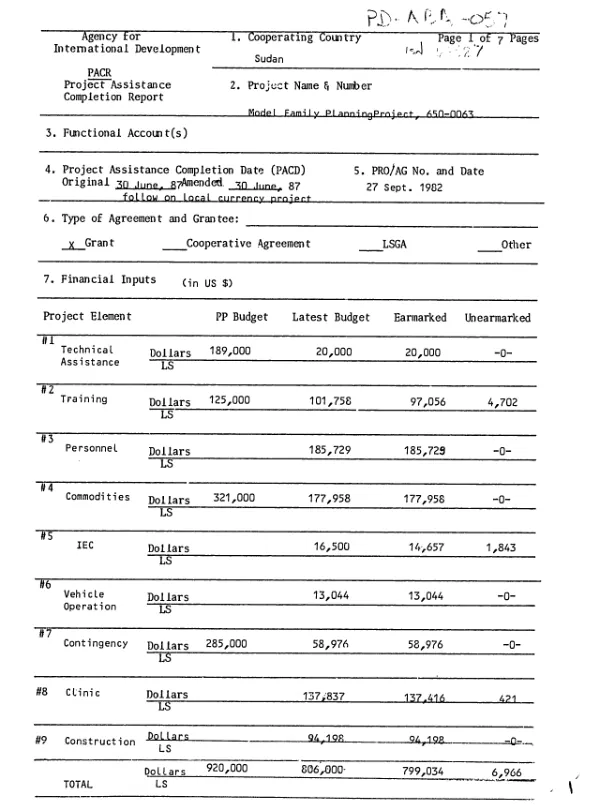
Project assistance completion report : model family planning project
PACR of a project (1982-1987) to establish a maternal child health/family planning clinic in Khartoum, Sudan.
Sign in to readA free account is required to download.
Abstract
The Sudan Fertility Care Association (SFCA) was the implementing agency. Due to a political dispute over who was the correct official to sign the grant agreement (a matter that should have been clarified at the outset), the actual opening of the clinic was delayed until 7/86. During the delay, staff received salaries without having to work; this did not encourage an expeditious resolution of the problem. Despite the delay, the SFCA's part-time volunteer staff developed the clinic into an established institution with a full-time clinical and administrative staff providing service delivery, educational, and training functions. Good progress was made in many activities. The IEC, training, and administrative components were generally successful, although the failure of the evaluation component to materialize makes exact quantification of clinic achievements impossible. Training of physicians, nurses, and staff exceeded target. An estimated 70% of married women of childbearing age were reached by the IEC campaign against a target of 90% despite logistic difficulties caused by Sudan's political situation. All told, the clinic serves an estimated 31,000 people a year. However, only 28% of these receive family planning services. As a result, contraceptive prevalence has not grown as rapidily as expected: despite the city's increasing population, less than a quarter of the target of 165,000 woman-years of contraception was provided. Also on the negative side, the clinic is generating only 60% of its own revenues because it is providing more free services than initially expected. It is recommended that the clinic establish a sliding fee scale. The SFCA added an administration building to the project facility without prior authorization, causing considerable delay in closing down the project. In retrospect it was decided to authorize the building since there was virtually no possibility to recover the funds. The clinic's expensive surgical contraception equipment and training were unused due to lack of public interest. The demand for this service should have been determined before proceeding with the venture.
Related documents
![[Final evaluation of] access to clinical and community maternal, neonatal and women"s health (ACCESS) / maternal and child health integrated program (MCHIP)](https://covers.devme.ai/gen/25046.webp)
![Project assistance completion report [: Sudan renewable energy project]](https://covers.devme.ai/gen/9128.webp)