USAID. MISSION TO SUDAN
Project assistance completion report : Port Sudan refugee water project (650-0050)
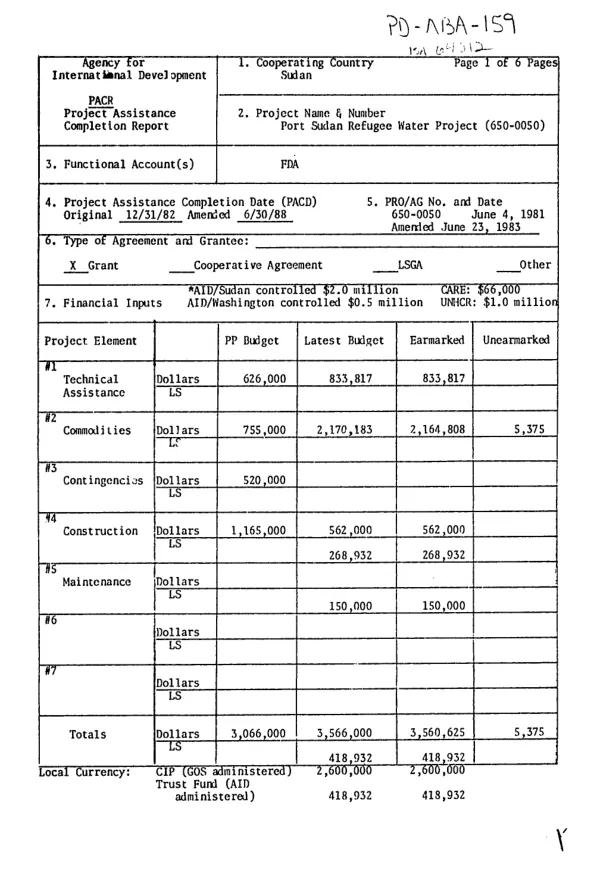
PACR of a project (1981-1988) to provide a potable water supply for refugees in the area of Port Sudan, Sudan.
1989
Sign in to readA free account is required to download.
Abstract
The project was delayed by flood damage in 1983, political problems between Port Sudan residents and refugees, and design and construction defects discovered in 1985. However, a remedial plan instituted in 1986 was implemented efficiently, and the water system is now operating as originally planned. The system consists of a slow sand filter with a 25,000 cu m capacity, along with a storage tank and 30 standpipes installed at the UN-funded Asotriba refugee camp. When surface flows are adequate, an additional 14,000 cu m per day of water is available for the municipal Port Sudan system. Phase I and II (through 8/84) were implemented under the direction of Sudan's Commmissioner of Refugees. This situation created many project difficulties. When the proper agency, the National Urban Water Corporation, was involved with the project during Phase III, implementation was smooth. Another lesson learned is that slow sand filtration for water treatment is a simple process viable for application in municipal water supply projects. These systems can be built, operated, and maintained by Sudanese communities. Furthermore, completed projects with design and/or construction problems can be salvaged with relatively low additional project costs.
Connected topics
Related documents
![Project assistance completion report [: Sudan renewable energy project]](https://covers.devme.ai/gen/9128.webp)