USAID. MISSION TO MOROCCO
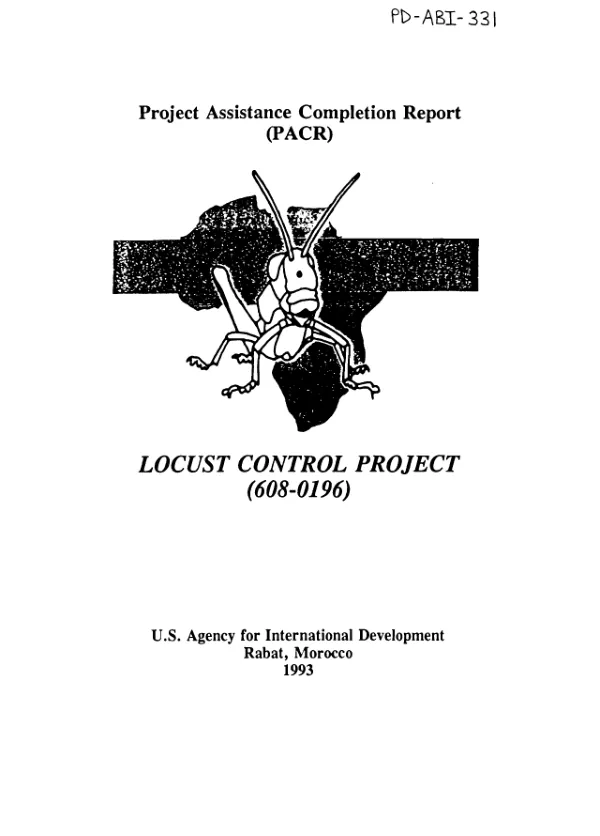
Project assistance completion report (PACR) : locust control project (608-0196)
PACR of a project (1988-6/92) to help the Government of Morocco (GOM) repel desert locust invasions.
1992
Sign in to readA free account is required to download.
Abstract
The project, which was well coordinated with other donor assistance, was a success, helping the GOM to increase its daily aerial and ground control capacity from 2,000 ha/day in 1987 to 30,000 ha/day currently. As a result, Moroccan crops and livestock were protected, with no reports of serious harm to human health. The project helped the GOM upgrade its pesticide storage facilities and equipment; acquire a well-trained cadre of experienced pilots, survey teams, radio operators, and crop protection technicians; and develop a highly effective control strategy, which was implemented through the National Locust Control Center (NLCC), to suppress locust swarms before they could cross the Anti-Atlas mountains. The NLCC, overseen by two Moroccan ministries, ensured a well-organized array of technical capabilities unique among locust control programs in the region. In addition, the project made several significant contributions to the GOM's capacity to protect human health and monitor environmental impacts by providing pesticide workers with protective clothing, cholinesterase test kits, and training in cholinesterase testing; by training Moroccan biologists in ecotoxicological assessment and analytical chemists in pesticide residue analysis; and by installing two gas chromatographs with phosphorus-specific detectors for pesticide residue analysis. These materials and training, coupled with Morocco's already excellent health care and safety education system, reduced the number of persons treated for organophosphate poisoning from 400 in the first campaign to 23 in the second campaign. In addition, the Denver Wildlife Research Center conducted an environmental impact study on the effects of dichlorvos (DDVP) and malathion (the two most widely used pesticides) on the fauna of Morocco. The following lessons were learned. (1) The NLCC was successful because of its highly disciplined organizational structure. (2) Continued functioning of a national locust control organization such as the NLCC is needed for ongoing preparedness. (3) The use of large aircraft in relatively unpopulated and nonagricultural areas proved feasible. (4) Future locust control projects should include funding for professional pesticide inspection services. (5) A regional approach to the prevention of locust outbreaks is essential. (6) To avoid overstocking, pesticides should, to the extent practicable, be ordered only as needed. (7) Pesticide management plans and cholinesterase testing kits should be included in all projects that provide pesticides. (9) Areas where pesticide spillage is likely to occur should be well-prepared to contain spills. (10) To the extent practical, wildlife censuses should be performed prior to large control campaigns.