USAID DEC
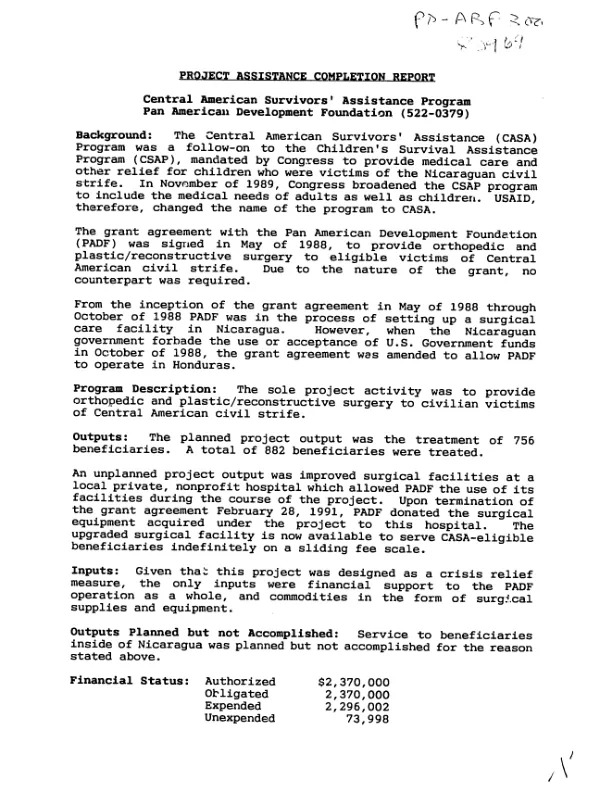
Project assistance completion report : World Rehabilitation Fund project (part of the Central American survivors' assistance [CASA] project)
Sign inUSAID. MISSION TO HONDURAS
Project assistance completion report : World Rehabilitation Fund project (part of the Central American survivors' assistance [CASA] project)
PACR of a project (5/90-2/94) to provide rehabilitation services to noncombatant victims of civil strife in Honduras.
Perez, Carla M. · 1994
Sign in to readA free account is required to download.
![Project assistance completion report : World Rehabilitation Fund project (part of the Central American survivors' assistance [CASA] project)](https://covers.devme.ai/gen/7068.webp)
Abstract
The project has been implemented by the World Rehabilitation Fund (WRF) and its newly created Honduran affiliate, the Honduran Rehabilitation Association (HRA). The project has exceeded its initial objectives; a total of 2,031 persons received rehabilitation services, such as fitting with prosthetic or orthotic devices, physical training, and family support training; 56% of the beneficiaries were under age 17. HRA is not only working with the disabled, it is one of the largest, if not the largest employer of disabled workers in Honduras. The approach used by WRF/HRA was the costly community-based rehabilitation (CBR) approach. The quality of service was judged good by most recipients, although response time (about 3 months) was considered too long; this was due in part to the geographic distances that made delivery in the community setting difficult. It should also be noted that WRF/HRA were helping to fill a huge need. WRF/HRA requested additional support in 4/93 which was denied because USAID felt that the CBR approach would always need external funding. Instead, USAID/H provided HRA with TA in management, marketing, and cost accounting through 8/94. A new highly qualified HRA manager is restructuring the production, administration, and accounting units of HRA and a marketing plan is being developed. HRA has already received small orders from El Salvador and local sales are rising steadily. The following lessons were learned. (1) Inclusion of a business component in the original design aimed at gradual self-sufficiency of the local implementing PVO (HRA) could have ensured development, as well as humanitarian impact. (2) A CBR program is labor-intensive and costly; the majority of HRA's 53 employees were more involved in rehabilitation services than in the production of prosthetic/orthotic devices for sale -- the key to the Association's sustainability. (3) Future CBR initiatives in Honduras should focus on developing the ability of the existing communities to locate external funding sources where needed, even if this means going outside the community and results in "primary or secondary" integration.
Related documents