USAID DEC
Project closeout report : handicapped rehabilitation and employment program (FUHRIL)
Sign inUSAID. MISSION TO HONDURAS
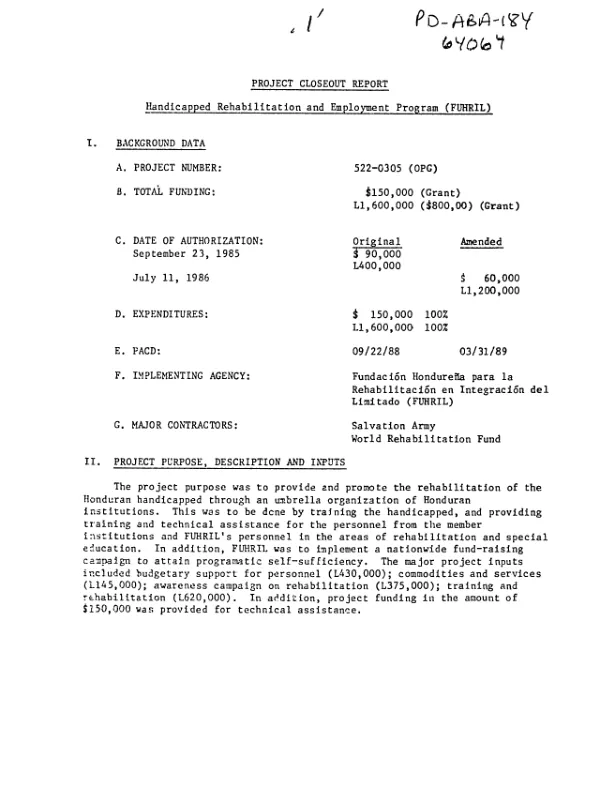
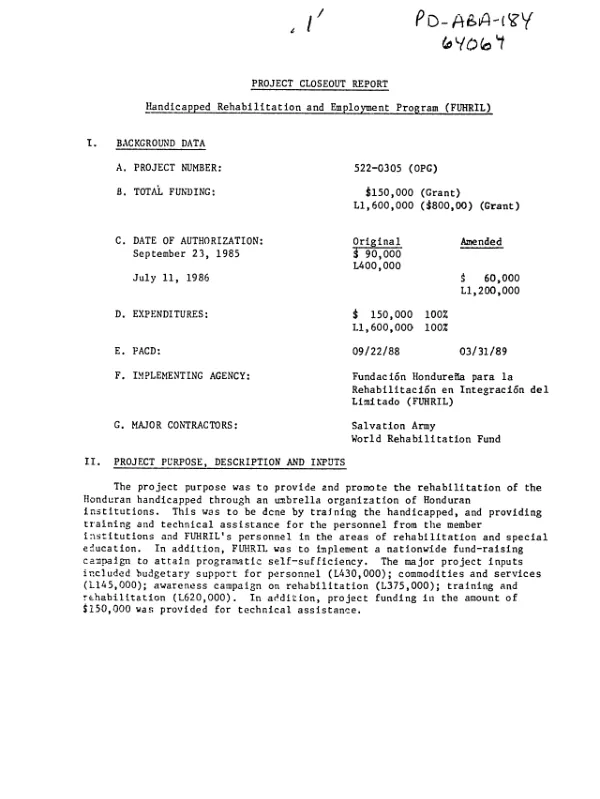
Project closeout report : handicapped rehabilitation and employment program (FUHRIL)
PACR of a project (9/85-3/89) implemented by Fundacion Hondurena para la Rehabilitacion en Integracion de Limitado (FUHRIL), a Honduran umbrella PVO, to support its handicapped rehabilitation services and to strengthen its funding base.
Sign in to readA free account is required to download.
Abstract
Results were mixed. On the positive side, with the exception of the number of pamphlets printed, all the target outputs of the project's training/community education components were surpassed, including the number of member PVO's involved, the number of institutional personnel trained in awareness campaigns and special education, and the extent of awareness campaign activities, e.g., conferences, television and radio spots, and printed articles. Additionally, FUHRIL has developed a modest source of income from its wheel chair, cane, and crutch fabrication shop, which is staffed and managed by handicapped workers, and from the shops it recently took over from World Rehabilitation for assembling hearing aids and other items. Nevertheless, FUHRIL has not become financially self-sustaining. Designed to be the major source of income, a fundraising telethon was organized under an independent committee with guidance from FUHRIL and TA contractors. However, because it was not under direct control of FUHRIL, the committee took control of the telethon, severed ties with the PVO, and offered only a small percentage of the income raised by the telethon to FUHRIL. The telethon commitee then proceeded with the building of three rehabilitation centers, but FUHRIL was marginalized from the management of these centers and from the committee's income. As a result, FUHRIL had to change its income-generating strategies late in the project. New fundraising activities included establishing ties with the sponsor of the national lottery - Patronato Nacional de Infancia - and contacting the Ford and Kellogg Foundations, European donors, and the Honduran private sector. The new funding ensured FUHRIL's survival as an institution and allowed the organization to continue training and rehabilitation services for handicapped persons. However, FUHRIL's services to its members as well as the developmental impact of its activities have been limited. Despite these shortcomings, FUHRIL deserves special recognition for what it achieved given the project's short time period and limited funding. Two lessons were learned. (1) Social services such as rehabilitation and training of handicapped persons cannot be transformed into net income generators; activities of this nature require continuing donor support from private or public sector sources. (2) Certain conditions precedent to the disbursement of funds for the telethon should have been included in the project agreement with FUHRIL to ensure that outside interests could not take advantage of these project investments.
Related documents