USAID. MISSION TO SWAZILAND
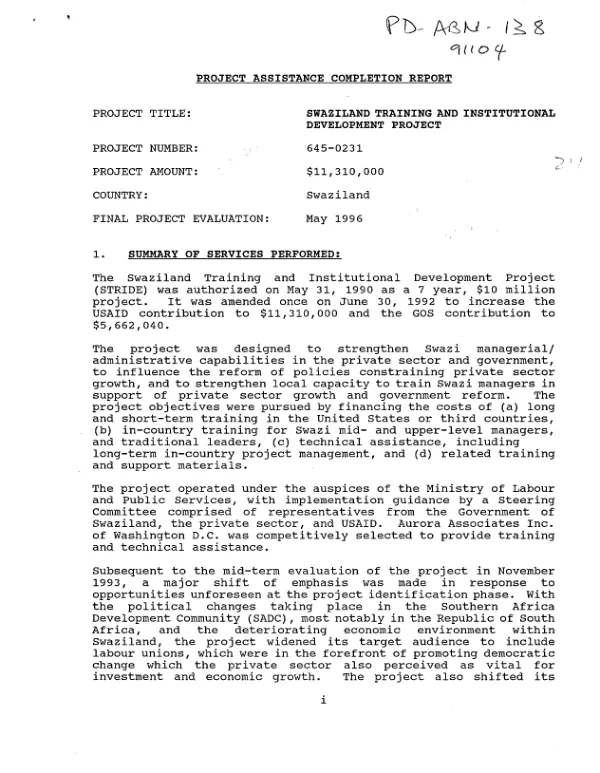
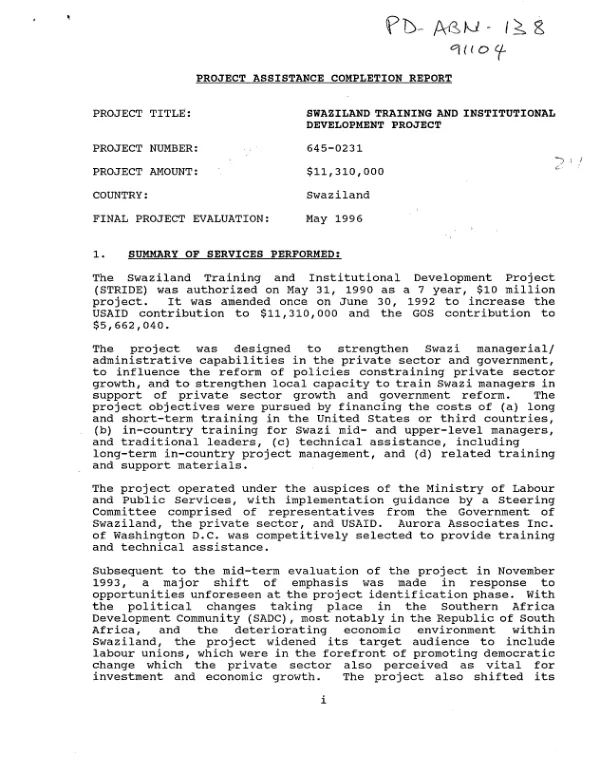
Project completion report [: southern Africa manpower development]
Final Mission Report on the Swaziland component of Southern Africa Manpower Development Program (1978-84).
1988
Sign in to readA free account is required to download.
![Project completion report [: southern Africa manpower development]](https://covers.devme.ai/gen/9390.webp)
Abstract
1. Summary: This project provided GOS organizational units with OPEX staff who maintained high-level operational efficiency in these units while counterparts were being trained to assume or resume responsibilities. Several Opexers and participants have been transferred to the Swaziland Manpower Development Project (SWAMDP) (645-0218) and the remaining project funds have been deobligated and reobligated into SWAMDP and AFGRAD. Swazi nationals in positions of responsibility with substantive inputs into the planning, design and implementation of the GOS's development programs were sent for advanced training. 2. Status of Completion: The project purpose was to reduce critical personnel constraints, mainly in the fields selected by U.S. Congressional mandate, while strengthening the public sector's capability to meet the development needs of the country. A total of 300 long- and short-term participants have been trained in the U.S., but these have not replaced U.S.-funded personnel as was expected. The planned output of some 420 nationals being trained in approximately 13 in-country training programs and courses was cancelled. Of the 6 "spin-off" donor-supported projects estimated as a project output, the Swaziland Manpower Development Project has been the only direct "spin-off." A marked improvement in efficiency has been observed in departments where OPEXers are or have been working. 3. Accomplishments in Terms of Project Purpose: During the life of the project, over 200 participants were trained and are now working in GOS positions that influence policy and development issues. Most of the staff of the GOS Tax Commission, including the Assistant Commissioner of Taxes and the Principal Tax Inspector, were project participants. These former participants are credited with influencing the GOS decision to expand its revenue base and improve tax collection procedures. A new sales tax was introduced in 1984 and since has increased revenue significantly. Most of the key staff at the Central Statistical Office, including the Chief Statistician, are former participants. Two of the major financial institutions in the country have former participants in key administrative positions: both the General Manager of the Swaziland Development and Savings Bank and the Head of Research at the Central Bank of Swaziland are former participants who received the Master's in Economics under this project. The 1986 policy decision by the GOS to delink its currency from the Rand Monetary Area (RMA) was made easier by having trained individuals who could present arguments based on sound economic reasoning. In the Ministry of Agriculture and Cooperatives (MOAC), the Director of Community Development completed a Masters' program under this project and is currently responsible for liaison between the various ministries and the traditional sector government. In the education sector, this project has provided degree programs and upgrading of degree status to members of the faculty of the University of Swaziland. (Author abstract)