USAID DEC
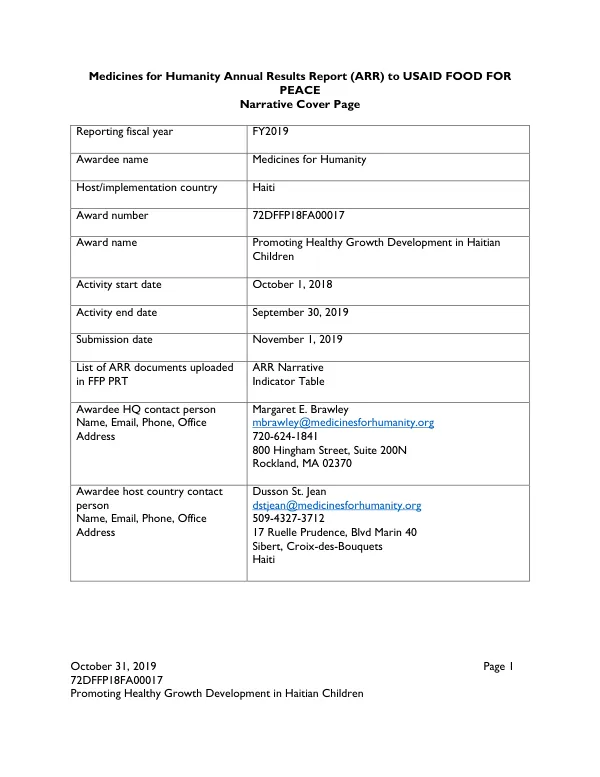
Promoting Healthy Growth Development in Haitian Children
Medicines for Humanity (MFH) implemented an FFP-funded IFRP project, Promoting Healthy Growth Development in Haitian Children, to increase the nutrition security of 12,000 at-risk children aged 6-24 months in target communities of rural and urban Haiti.
2019 · 14 pages
Sign in to readA free account is required to download.
Abstract
The project aimed to provide Nutributter, a nutritional supplement, to children identified as malnourished or at risk of malnutrition. In FY2019, MFH completed three of the four agreed-upon milestones. The entirety of the Nutributter product was transported to Haiti in FY2019, delivered to eleven partner clinics throughout the country, and is currently being distributed to targeted children according to the modified implementation plan. MFH and its seven partners at the eleven clinics successfully implemented activities despite facing challenges throughout the first 12 months of the project. A baseline assessment and census/registration process was conducted in October and November 2018 to identify households with children aged 6-24 months. Community Health Workers (CHWs) were trained on assessment protocols to ensure a random sample was taken and all procedures were followed. Collected information included family name, child name, age, and Middle Upper Arm Circumference (MUAC). Children identified at risk for malnutrition or normal weight were registered for the Nutributter distribution, while those identified as malnourished were referred to the nearest clinic with a nutrition program to receive treatment and Plumpy'Nut. Two shipments of Nutributter were transported to Haiti in January and August 2019, with a total of 45.36 MT of product received and properly stored at each clinic. Clinic distributions of Nutributter began in six partner clinics in March 2019 and subsequently in five additional partner clinics in late September and into October 2019. Children enrolled in the program and their caregivers came to the clinic once per month for 6 months to receive a 30-day supply of the product. Before each clinic distribution, the nurse conducted nutrition education and discussed the benefits of Nutributter, breastfeeding, and a healthy, complementary diet for children. The project coordinated distribution of Nutributter with other clinic-level nutrition programs, such as the treatment of malnutrition. Children transitioning out of the clinics' malnutrition programs were eligible to receive Nutributter to prevent relapse. The project was also integrated with other clinical services for children and mothers, including clinic consultations and treatment for common illnesses. MFH encountered several challenges during the first year of the project, including discrepancies in the total number of children identified in the initial census and the target communities. Some mothers were unmotivated to come to the clinics to receive the Nutributter supplement due to food insecurity and the desire for full meal rations for the family. Despite these challenges, MFH and its partners successfully implemented activities and distributed Nutributter to targeted children.
Related documents