USAID DEC
Promoting the Quality of Medicines (PQM) Program Quarterly Reports: FY13 Activities (October 1, 2012–September 30, 2013)
Sign inTHE GLOBAL FUND TO FIGHT AIDS, TUBERCULOSIS AND MALARIA
Promoting the Quality of Medicines (PQM) Program Quarterly Reports: FY13 Activities (October 1, 2012–September 30, 2013)
The Promoting the Quality of Medicines (PQM) Program is a global initiative aimed at improving the quality of medicines, particularly in low- and middle-income countries.
2013 · 48 pages
Sign in to readA free account is required to download.
Abstract
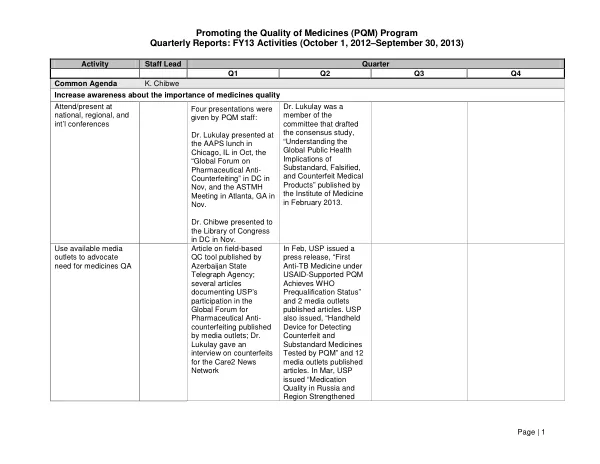
The program's quarterly reports for FY13 activities, spanning from October 1, 2012, to September 30, 2013, highlight key achievements and progress made in various areas. One of the primary objectives of the PQM program is to increase awareness about the importance of medicines quality. To achieve this, PQM staff members attended and presented at various national, regional, and international conferences. Dr. Lukulay presented at the AAPS lunch in Chicago, IL, the "Global Forum on Pharmaceutical Anti-Counterfeiting" in DC, and the ASTMH Meeting in Atlanta, GA. Dr. Chibwe presented to the Library of Congress in DC, and Dr. Lukulay was a member of the committee that drafted the consensus study, "Understanding the Global Public Health Implications of Substandard, Falsified, and Counterfeit Medical Products" published by the Institute of Medicine in February 2013. The PQM program also utilized available media outlets to advocate for the need for medicines quality assurance. Articles were published by Azerbaijan State Telegraph Agency, several media outlets documented USP's participation in the Global Forum for Pharmaceutical Anti-Counterfeiting, and Dr. Lukulay gave an interview on counterfeits for the Care2 News Network. USP issued press releases on the first anti-TB medicine under USAID-supported PQM achieving WHO prequalification status and the handheld device for detecting counterfeit and substandard medicines tested by PQM. In addition to awareness and advocacy efforts, the PQM program focused on providing technical assistance (TA) to manufacturers of second-line anti-tuberculosis (TB) medicines. Dong-A Pharmaceutical Company was WHO prequalified in November 2012 for Cycloserine 250 mg capsules. TA continued to be provided to manufacturers in different stages of compliance with WHO prequalification, including Phapros, Indofarma, Dong-A, Arterium, Zhejiang Hisun Pharma, Shalina, Deurali Janta Pharma, Akrikhin, Simpex, Abbott, Sintez, and Farmasintez. The PQM program also collaborated with the Global Drug Facility (GDF) and the World Health Organization (WHO) to conduct workshops in high-burden countries, identify additional manufacturers not yet in the PQM pipeline, and provide technical assistance to key second-line anti-TB API suppliers to WHO prequalification. Zhejiang Hisun Pharma, Fuzhou Fuxing Pharma, North China Pharma, Dankang Pharma, and Zhejiang Xinhua Pharma were identified as key API suppliers. Furthermore, the PQM program supported regional approaches and networks by contributing to NEPAD's Institutionalization of Regulatory Training Programs in Africa using Existing Regional Structures Technical Working Group (TWG). Dr. Karim Smine presented at the first meeting of the African Medicines Regulatory Harmonization TWG on Regulatory Capacity Development in Africa held in November 2012 in South Africa. The PQM program also explored improved tools to ensure quality control or increase the knowledge base about quality assurance. A field-based QC tool with increased accuracy, sensitivity, and reliability was developed, and a PharmaCheck prototype was developed to undergo optimization. The program also conducted GMP assessments and mock inspections for manufacturers, including Abbott's CMO (Akorn) and Hisun Pharma. In the area of malaria, the PQM program conducted studies to assess the diversion of antimalarial medicines from the public to the private sector. A protocol was developed for an antimalarial monitoring study in new countries, and one study was underway in Congo Brazzaville. Two studies were completed in Congo Brazzaville, and reports were completed and disseminated.
Related documents