USAID DEC
PROPEL Adapt Family Planning and Reproductive Health Resilience Health Advocacy Toolkit
Sign inACTION AGAINST HUNGER
PROPEL Adapt Family Planning and Reproductive Health Resilience Health Advocacy Toolkit
The USAID PROPEL Adapt project is a five-year cooperative agreement aimed at strengthening health systems and promoting resilience in countries facing shocks and stressors.
2024 · 21 pages
Sign in to readA free account is required to download.
Abstract
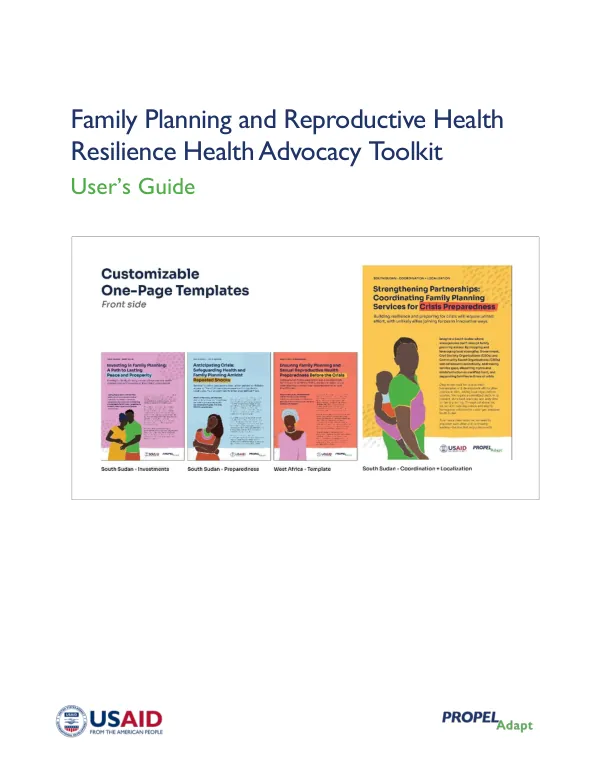
Led by Action Against Hunger-USA, the project is implemented in collaboration with Amref Health Africa, Pathfinder International, Action Against Hunger-Canada, Acción contra el Hambre-Spain, and Action contre la Faim-France. PROPEL Adapt focuses on improving access to healthcare services, supplies, and information, with a particular emphasis on voluntary family planning and reproductive health (FP/RH) and its integration with HIV/AIDS and maternal and child health. The project's primary objective is to equip humanitarian and development actors with effective messages and tools to advocate for the continuity of essential FP/RH services during crises. PROPEL Adapt aims to address the detrimental effects of disruptions to primary healthcare, including FP/RH, which are evident in events such as COVID-19, climate-induced disasters, and recurring conflicts. A desk review of existing advocacy tools revealed gaps in messaging that promote coordination, local preparedness, and improved investments in FP/RH to enhance resilience and preparedness at the country level. To address these gaps, PROPEL Adapt conducted a global co-creation workshop in July 2023, which brought together experts from different sectors to co-create messages that resonate with the values of target decision-makers. The FP/RH Resilience Advocacy Toolkit is a set of materials designed to support advocates in making the case for FP/RH resilience and to advance policy asks. The toolkit includes key messages, data, and templates that can be adapted for use in any country. It features examples from Pakistan and South Sudan, where disruptions in health services and population displacement due to crises have occurred. The toolkit is designed for use by advocates, including international humanitarian organizations, family planning and reproductive health implementers, community-based organizations, grassroots civil society organizations, and champions within government ministries and policymakers. The toolkit's purpose is to provide advocates with a validated advocacy package that can be adapted to suit specific countries or regions. The toolkit includes key messages aimed at policymakers, donors, and non-governmental organizations (NGOs), as well as country-specific key messages for South Sudan and Pakistan. It also features a global fact sheet, country fact sheets, one-pagers, and plug-and-play templates that can be customized to match the branding and needs of organizations. Advocates can customize the toolkit's materials by selecting key messages and facts, reviewing their country's FP2030 commitments, and searching for key FP/RH indicators. They can also select plug-and-play templates and customize them to create leave-behind materials or social media graphics. The toolkit is designed to be adaptable and can be used by any country advocate to make the case for FP/RH resilience and to advance policy asks.